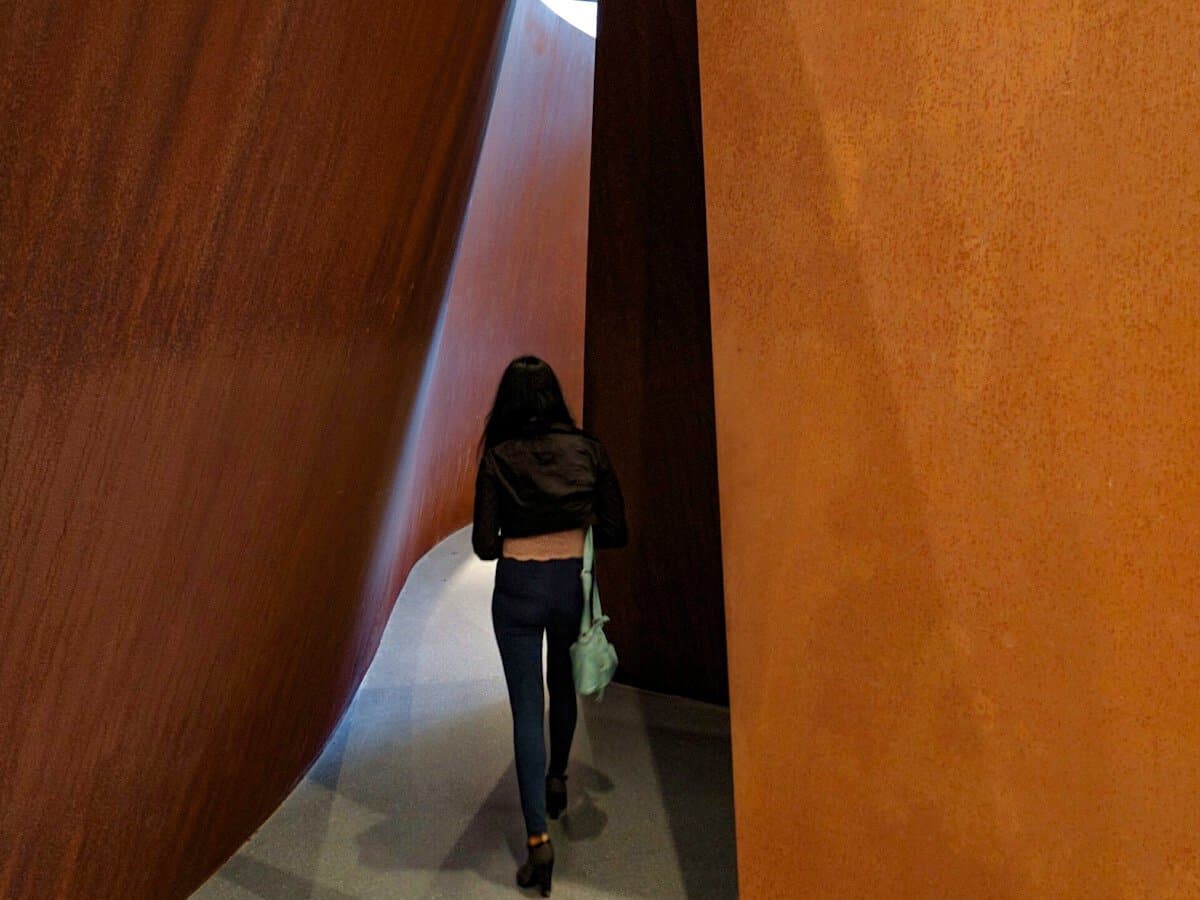
Born in San Francisco in 1938, Richard Serra always remembered the first time his father took him to the shipyards for his fourth birthday. His father was a Spanish immigrant who worked as a pipefitter on the docks. They watched a steel tanker launch. The size of the hull, the curves of its steel, and the massiveness of its surroundings will find their way into the monumental yet intimate sculptures Serra later created.
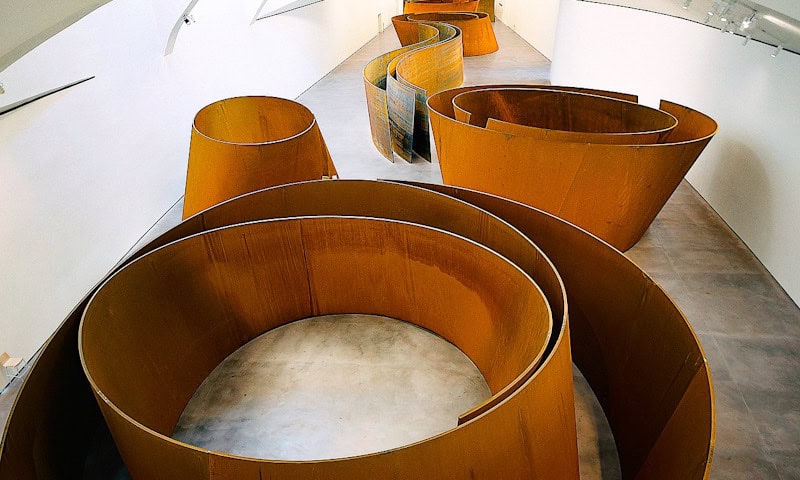
Serra, The Matter of Time (2005)
“All the raw material that I needed is contained in the reserve of this memory, which has become a recurring dream.”
Literature and Muralism
First, he drew them – sketches that impressed his parents and his teachers. But at U.C. Santa Barbara, he took up literature instead. He studied alongside Aldous Huxley and Margaret Mead. He read the poetry of Walt Whitman. Emerson became his Bible. Thoreau taught him the virtues of self-reliance. He wrote his thesis on Camus and existential philosophy.

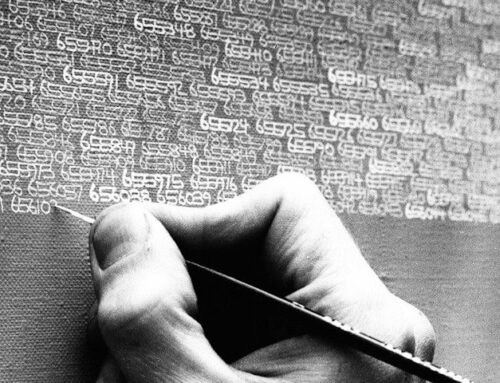
Serra, Verb List (1967)
This list was instrumental for Serra's Process Art, which involves a particular physical action when creating art and sculpture.
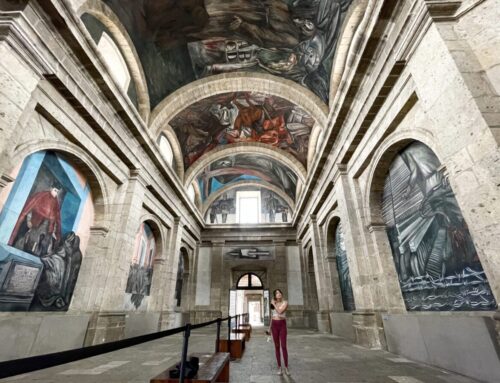
In the summers, he worked at steel factories and watched the building of modern architecture in Downtown San Francisco. Once, he hitchhiked to Mexico to see the works of the Muralists. He was deeply moved by Orozco’s murals at Hospicio Cabañas.
“The sheer strength of the work, the way it wrapped around the interior, the power of his murals completely reconfigured the space. The walls are almost demolished, crumbling under the weight of death and destruction.”
It was the first time he saw how art can affect architecture, how it can change the sense of space and give it meaning.
Yale and the Bauhaus
He came to Yale to study painting and art history. In the company of the likes of Chuck Close, Robert Mangold and Nancy Graves, his self-confidence in painting wavered. The competition among students was fierce, but art was evolving. While Abstract Expressionism still dominated, assemblage and pop art were exploring new mediums. Yale’s curriculum was augmented by visiting artists. Frank Stella, Rauschenberg and Philip Gaston came to give lectures.
At that time, the art department was greatly influenced by the Bauhaus. The classes explored non-traditional methods and stressed the use of non-art materials. There was a course on Josef Albers’ color theories. Serra even peer-reviewed The Interaction of Color, Albers’ landmark book on color experimentation. He developed an eye for saturation and tone and learned to discern minute variations.
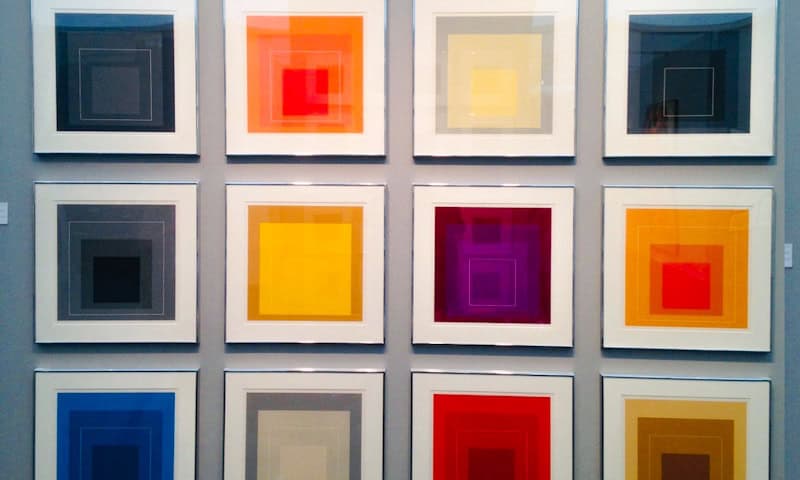
Albers, Homage to the Square
Albers' color theories broke away from the color wheel and put them into context, revealing the ways colors can deceive and change in variations, temperature and essence.
Europe and Giacometti
In 1964, Serra was granted a fellowship to study abroad. In Paris, he sought out Giacometti, whose imposing bronze human figures explored the spatial dynamics of sculpture. He visited the studio of Constantin Brâncuși, the late Romanian artist who’s considered the patriarch of modern sculpture. Serra would later refer to him as an encyclopedia of content, space and form.

Giacometti, Sculptures
Giacometti's existential works are explorations on the human condition.
Then he went to Madrid and saw works by Velázquez. Velázquez was brilliant, and Las Meninas was a revelation. It gives the illusion that the painter is looking at the viewer as if the viewer is the subject of the painting. This pulling in of the viewer, making him part of the art, is where Serra would eventually take sculpture.
But at that moment, what he felt were the confines of painting, how it limits everything to a frame. He wanted to get away from that pictorial space. The following year, he went to Italy on a Fulbright Scholarship. He fell in love with the Florentine masters, particularly Uccello and Fran Angelico. But he felt the same about the framing.
“I might as well be looking out the window. All I’m doing is looking at painting inside a frame.”
Then he saw the sculptures of Clemente Susini, wax models depicting dissected corpses and stuffed cadavers. He began experimenting with assemblage, taking cages and filling them with stuffed animals, a metaphor for illusion and reality. He got things from thrift stores and junk shops and explored the use of non-art materials. The Arte Povera movement was just taking shape. In Rome, Serra used live animals in an exhibition, and the police closed down the gallery. Three years later, Janis Kounellis lined up his famed Twelve Live Horses in a similar space.
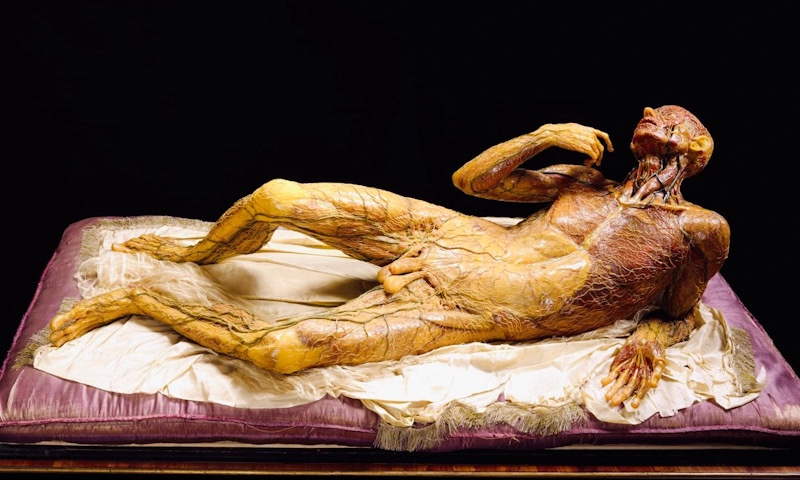
Susini, Model of a Skinless Man (1794)
Susini's sculptures were studies in anatomy.
New York and Minimalism
He came to New York in 1966 at the height of Minimalism with Ellsworth Kelly, Sol LeWitt, Donald Judd and Dan Flavin at the forefront. A direct response to Abstract Expressionism, minimalist art and sculpture were dominated by simple lines and basic geometric forms and claimed to be devoid of representation. Fiberglass, aluminum and other industrial products were incorporated, similar to early Soviet-era Constructivism.
Conceptual and performance art were also becoming more experimental. There was a cross-influence of art and mediums. Artists were beginning to focus more on the process of making art rather than the finished art itself. Serra continued to explore new methods, new mediums and new materials. Once, a warehouse discarded excess rubber out onto the streets. He hauled away as much of it as he could.
Belts is part Pollock’s Mural and Cleas Oldenburg hanging sculptures. All the time Serra spent at shipyards and working at steel factories gave him an innate sense of how to utilize industrial materials. He knew their weight and their flexibility.

Serra, Belts (1967)
Leo Castelli and Jasper Johns
In 1968, he was invited to take part in 9 at Castelli, a groundbreaking exhibition of large and abstract sculptures by emerging artists. Around this time, composer Philip Glass, then a friend and assistant of Serra, suggested using lead.
Serra came to the gallery and installed his piece by casting molten lead on the wall where it met the floor. Lead melts at lower temperatures than other metals, and it cools and hardens faster. It’s almost as malleable as rubber. The dried, splashed lead is alluring and lace-like when stripped away.
The process is two-fold in melting and shaping the lead. And not only was it sculpted directly into the space, but it changed the architecture of the room. The gallery was a warehouse space of unvarnished walls and bare concrete floor, and the piece just made sense. It was a dramatic shift from main school Minimalism and hailed as “The New New York Avant-Garde.”

9 at Castelli, 1968
“I think abstraction has been able to deliver an aspect of human experience that figuration has not.”
To Serra, it was a way of taking on the architecture of a room, using art to change and challenge the space. The exhibition led to numerous commissions, and he made a series of splash/cast pieces the following year. Two were in Europe – one for the Stedelijk Museum in Amsterdam and one for Kunsthalle Bern in Switzerland. Back in New York were for two more exhibits, and the last was a special request for Jasper Johns’ Studio.
While working on the Splash Piece/Casting for Jasper Johns, there was a piece too large to melt. He propped it to splash against and discovered it could stand on its own. He became interested in balance and the tectonics of building. In One Ton Prop, he leaned four unaltered plates against each other, using tension to hold pieces together with nothing else. It is austere and poetic – the way each one holds the others up.

Serra, One Ton Prop (1969)
Space as Sculpture
Around this time, LACMA introduced its Art and Technology program, which pairs artists with companies that provide funding and technical expertise. Serra worked with Kaiser Steel at their Fontana stockyard. He experimented with cutting, stacking and balancing six-ton slabs of cast steel using construction machinery.
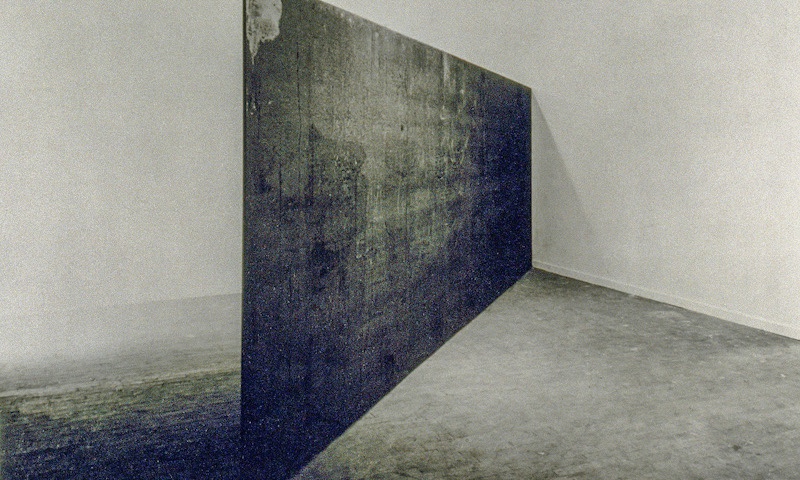
Serra, Strike (1971)
“I began to think about the spectator walking through and around a piece in time rather than just looking at an object.”
Having learned the technical properties of steel, he moved on to bigger plates. At Kassel’s Documenta, he wedged four plates against the corners of a room, with nothing else holding them in place. Circuit dissected the room, making sculpture out of space. Viewers had to walk between the plates to observe and address their physicality. Space and movement were all part of the experience.
Site-Specific Shift
When he received a series of commissions for outdoor spaces, he first had to study balance and tectonics in outdoor settings, which allowed for much bigger sculptures. For the Kröller-Müller Museum in Amsterdam, he chose a small valley in the sculpture garden for the installation. Spin Out is made of three steel plates placed at the foot of the slope. Part of them are wedged into the earth, and the rest are exposed and free-standing. The work is both a confrontation and an intervention of viewer and landscape.
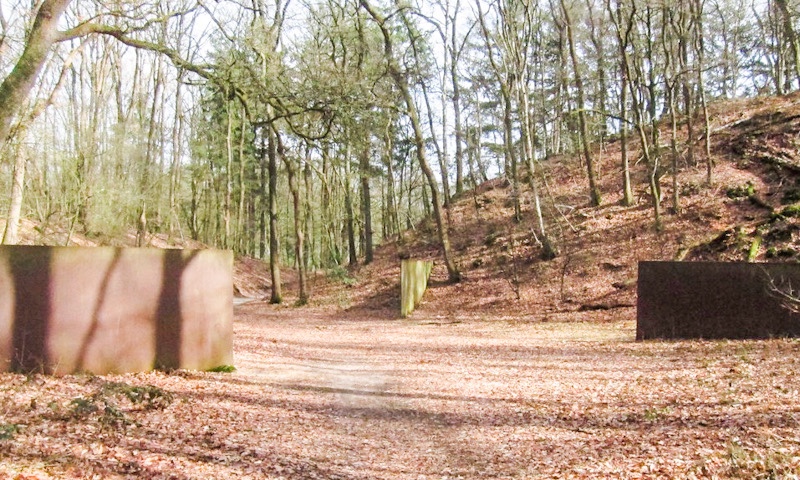
Serra, Spin Out (1973)
This time marked the beginning of his site-specific sculptures. Pieces were conceptualized for and inspired by the exact location they’ll inhabit. When he was commissioned to create a sculpture for a plaza by the Holland Tunnel exit, it became another path for exploration. It was an urban location for the wider public, a departure from museum and gallery spaces and their art audiences. In addition to location, the amount of people and traffic moving along the space was an element to consider.
“What I try to do is articulate space. How do you do that in other contexts? How do you challenge those spaces, changing them into places that deal with volume in a way that hadn’t been done before?”
The Tilted Arc Controversy
The following year, Tilted Arc was installed in Downtown Manhattan. The government-funded Art-in-Architecture program commissioned the project, and The National Endowment for the Arts recommended Serra. Unfortunately, the wider public’s reaction was adverse, and employees working around the plaza complained that it was disruptive to their daily routine.
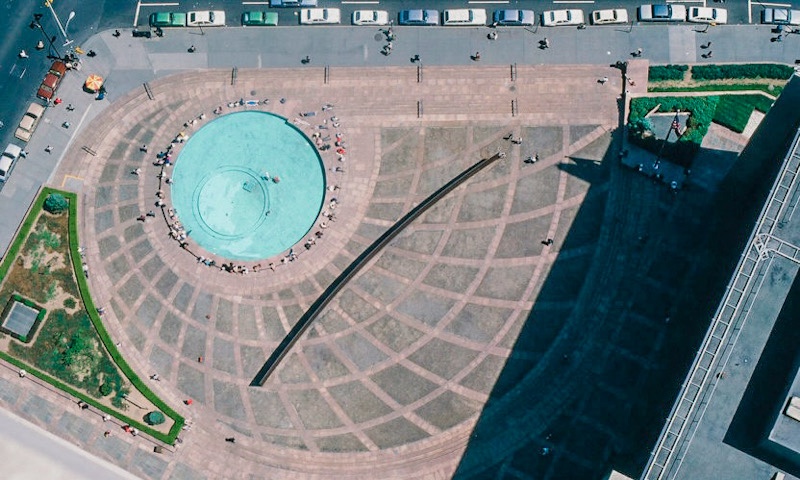
Serra, Tilted Arc (1981)
The government wanted to move it, but Serra argued that to move a site-specific work was to destroy it. A lengthy legal battle followed, with artists, architects and historians fighting for preservation. Serra would eventually lose, and the piece was discarded. But Tilted Arc initiated a more extensive debate on artists’ rights and the role of public art.
Movement as Sculpture
The controversy did not deter him. His sculptures became grander and more complex, using an increasing number of plates and arrangements. What started as an arc bent into Torqued Ellipses. They are abstract, geometric sculptures the viewer can move in and inhabit. Here, the viewer is almost entirely enclosed within a single, tilting, free-standing form.
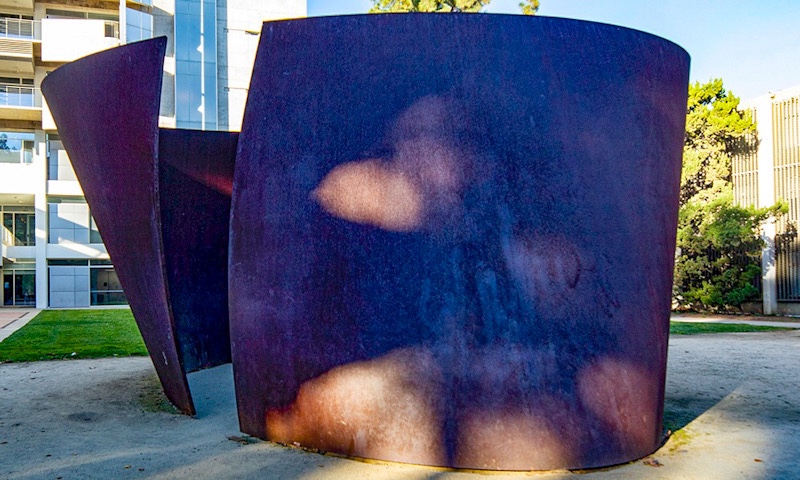
Serra, Torqued Ellipse UCLA (2006)
The variations in color are caused by oxidation, turning into a rich, deep amber in about ten years.
“These pieces bear psychologically on the viewer in a more intense way.”
There wasn’t a precedent for what he was making. It took time and experimentation, trials and models, a study of the earth and materials, even the use of software made for building and architecture. On the surface of his first ellipses are scars from force, heat and struggle. He was yet to perfect balance, and the bottoms didn’t always align with the ground. Only when one of the massive steel plates broke with the pressure of bending did he learn of its limits.
Serra had over a hundred commissions, from Maine to San Francisco, Qatar to São Paulo, and all over Europe. His sculptures took years from conception to installation, not to mention the sheer weight of the steel. The Matter of Time weighs almost 1,000 metric tons. Everything was planned to the smallest fractions. When MoMA underwent renovations, it came with a stipulation that there had to be a gallery large enough to exhibit his works.
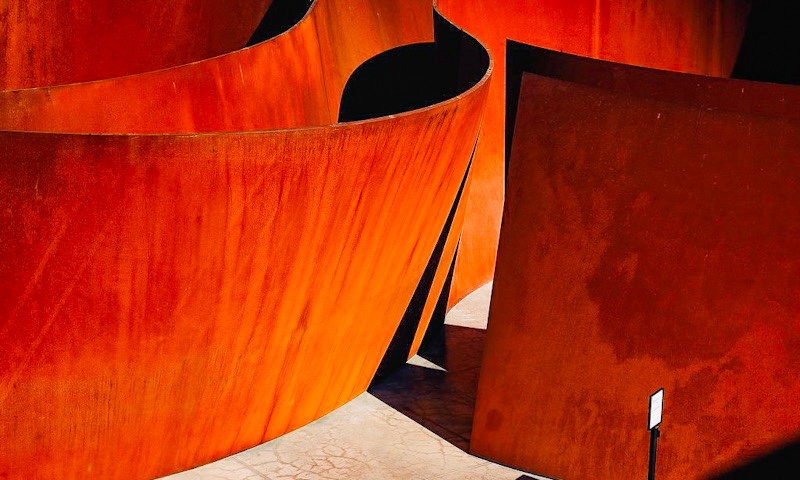
Serra, Sequence (2006)
So then came a maze of sculptures, monumental arcs, leaning corridors and intimate passageways that rhythmically hold movement and space. Serra credited the Church of San Carlo as an influence – a masterpiece of Baroque architecture with curved interiors and an oval dome of intricate geometry. There’s something endearing about this clash of inspirations – the steel mills where he used to work and a church that dates to 17th-century Rome, a confluence of the industrial and spiritual into a perfect harmony of form and space. The sculptures force engagements. They are meant to be viewed while in motion and require constant attention. You don’t see them so much as feel them. And there’s a pleasure in that, in art that beholds you.
“Everything we choose in life for its lightness soon reveals its unbearable weight.”