An immigrant from Nola, Italy, Simon Rodia passed by the architecture of Naples and the east side of the U.S. before being among the 1.2 million newcomers who settled in Los Angeles in the 1920s. While working in construction, he started making planter boxes, bird baths, fountains, and even a merry-go-round for himself and as gifts for his neighbors.
In 1921, he began to build what would be known as the Watts Towers. He bought a small house on a triangular piece of land on a dead-end street beside railroad tracks that carried almost 75,000 people across a week. Somewhat inspired by the Tower of Pisa and the annual Giglio Festival in his hometown, he called the structures “Nuestro Pueblo” as engraved over the entrance with his initials. “Our Town.”
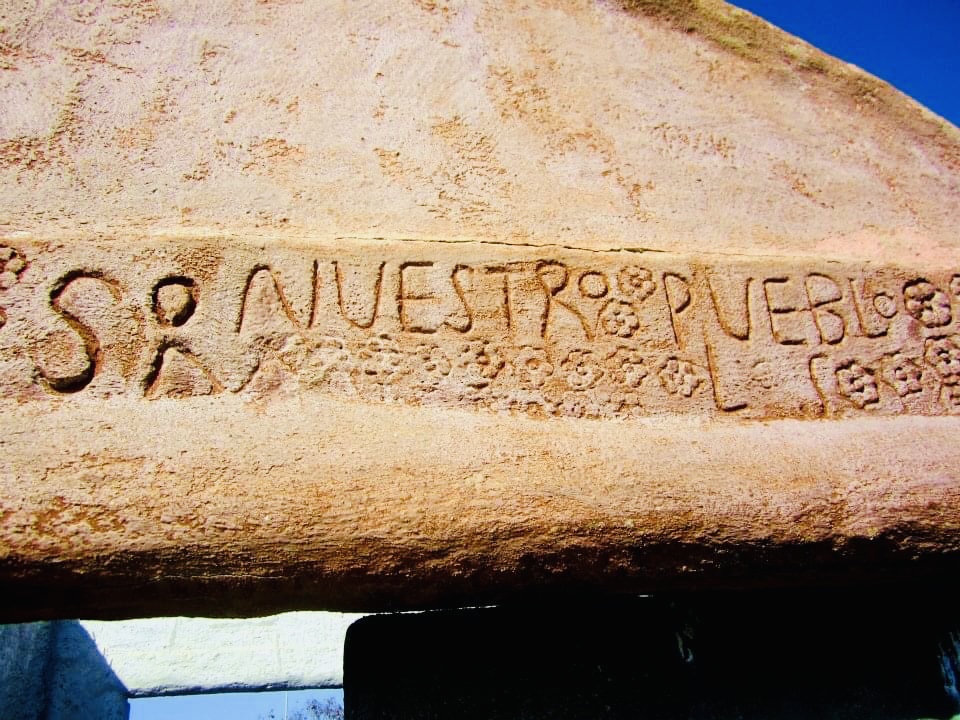
He built everything – shaped every piece of glass, carried every pail of cement, welded every piece of steel, engraved every design in concrete – by hand. He spent all of his spare time, even nights, building the towers inch by inch, all on his own, without any help, using the railroad tracks to curve the steel rods by sliding them underneath and bending them. He had only the most rudimentary tools – a hammer, pliers and a shovel.
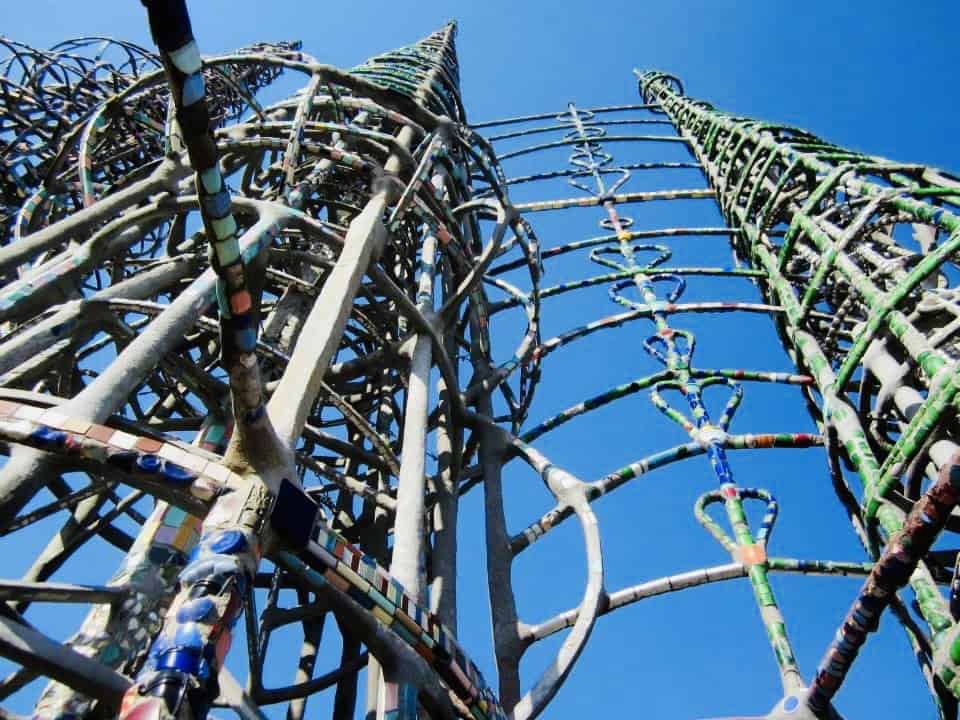
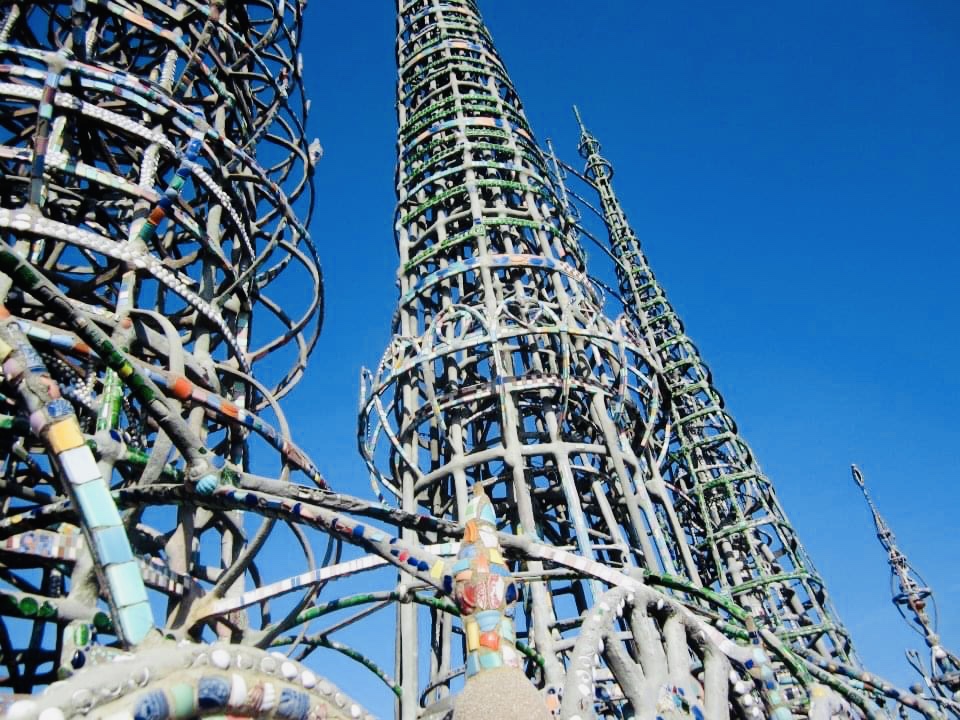
Rodia later explained that he didn’t have the money to hire helpers, nor could he tell other people what they needed to do because he didn’t know himself. He had no plans or drawings for the site. Yet he instinctively used techniques, like cementing in mesh wire, which was uncommon during that time but would later prove important in buildings that can withstand California’s fierce winds and earthquakes. He dug trenches for the foundations and cemented long pieces of steel vertically into the ground. The towers are made of a steel core, wrapped in wire, and inlaid with mortar before he cemented in the decorating tiles.

In 1933, a 6.4 magnitude earthquake hit. Though the Watts Towers survived intact, Rodia widened the bases and added heavy rocks, then buttresses between the structures for support. He was illiterate, but his building techniques were ahead of his time, which is part of what makes the towers so impressive to artists and architects alike. Architect and inventor Buckminster Fuller, known for the geodesic dome, called Rodia’s use of structural building techniques “intuitive intelligence and the dynamics of genius.”
The towers and spires seemed to have been modeled after the ceremonial towers they paraded in the annual Giglio Festival in Italy held since the Middle Ages. It was to celebrate the liberation of Santo Paulinus, then Bishop of Nola, who was abducted along with his neighbors and held prisoner in North Africa. They were freed after Paulinus correctly interpreted his captor’s dream, and he became Nola’s patron saint. The “Ship of Marco Polo” that Rodia built on the east end of the Watts Towers resembles the ship they sailed home.

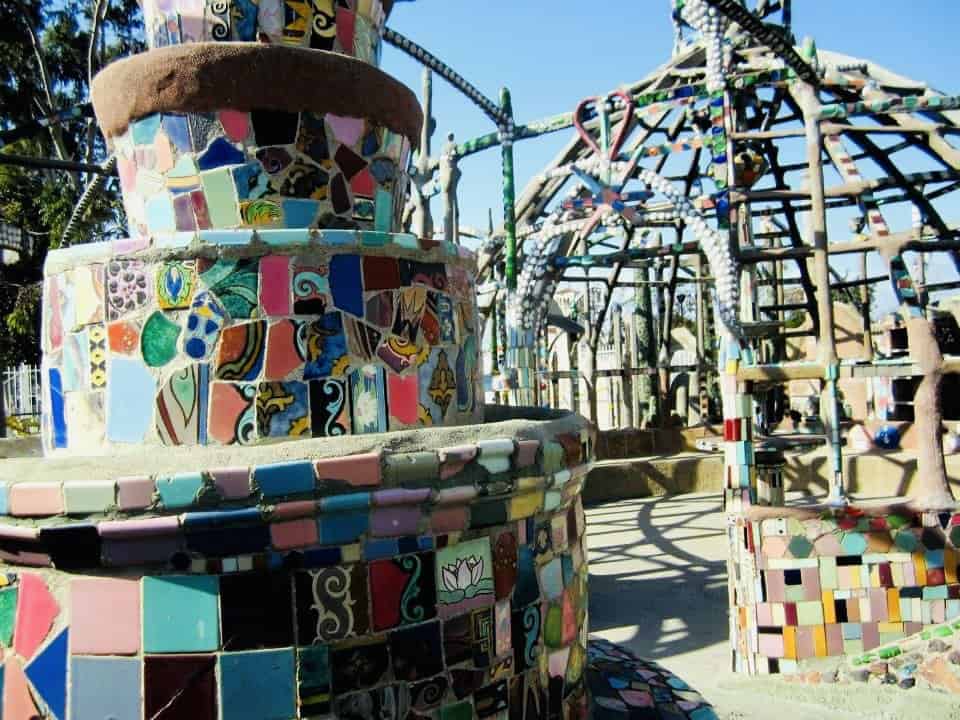
All the structures and the walls surrounding the Watts Towers are covered with seashells, tiles, bottles, and broken mirrors. It was a massive collection of discarded fragments – 11,000 pieces of pottery, 15,000 glazed tiles, 6,000 pieces of colored glass and 10,000 seashells. The former shapes and colors of soda bottles, the old logos of Noxzema and Clorox containers can be seen alongside hand-painted ceramics and house tiles used in California homes at that time. Many were Spanish or Asian-inspired, as was the growing immigrant population. The towers reflect such an eclectic timeline of art designs and commercial products that many consider it a modern archeological site.
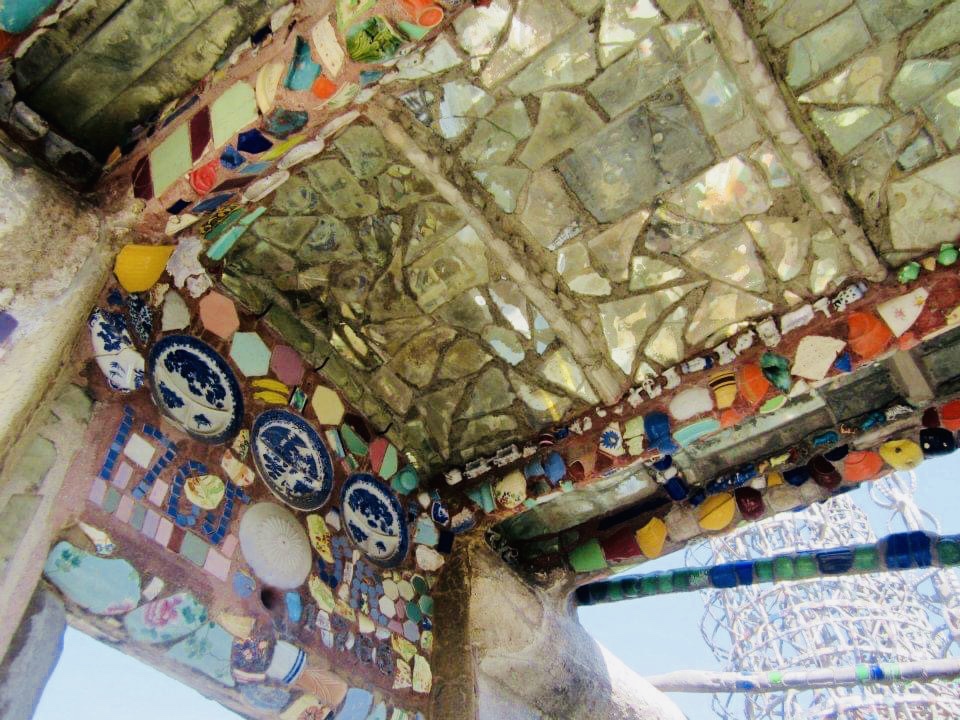
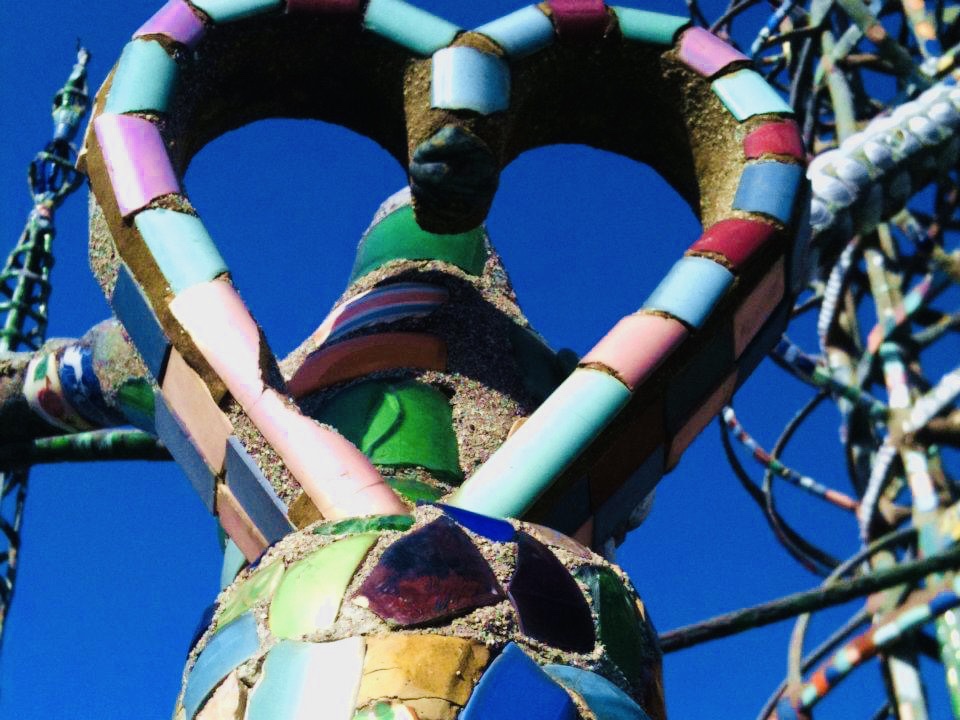
He engraved some of the wall panels and cement floors with patterns, using the scalloped edge of water faucets or the ribbed glass from headlights – flowers and symmetrical shapes, including hearts that he incorporated everywhere, even the buttresses between the spires – he shaped a metal heart on each rung. When asked what all the hearts mean, he simply answered, “You know…”
Because of its location, many people in passing trains saw the towers, and newspapers and magazines started to feature them. Rodia was an introvert, and with his heavy Italian accent, everyone misspelled his name, and nobody ever really understood what or why he was building.
In 1955, Rodia suffered a fall and was incapacitated for two days. After 33 years working on the towers, he handed the deed over to a neighbor and moved away, never to return. Because it was uninhabited, his house and the Watts Towers were constantly vandalized and the house was even set on fire. In 1957, the City Building and Safety Department issued an order to demolish the house. The tallest West Tower was ten stories high with a foundation only 18 inches deep. Because the city requirements were a minimum 24 inches, the towers were deemed unsafe and also set for removal.
What followed is perhaps one of the most successful efforts in landmark preservation. Local residents – artists, teachers, even writers – formed a committee to save the towers. They raised thousands of dollars and generated over a hundred news articles worldwide. Delegates from 15 countries came to protest the demolition.
In 1959, a 10,000-pound load test was applied to the towers, and while they stood firm, the steel cylinders pulling on them began to bend. The Watts Towers proved stronger than the strongest steel. The city chief removed the red “unsafe” sign and surrendered it and the site to the committee. Soon afterward, up to 50,000 people would come from all over the world to visit every year.
In 1964, the Watts Towers Art Center was established as a teen post for creativity. Today, art workshops, street theater, and jazz festivals are still held there. In 1965, The Watts Towers survived the infamous riots that damaged 288 other buildings and injured over a thousand people in the neighborhood. It was like something sacred was saved; even those most enraged couldn’t dare destroy it. As the neighborhood was slowly rebuilt, many houses would feature tiled walls in honor of Rodia.

In 1990, when New Zealand ambassador Dennis McLean visited Los Angeles for one day, it was only the Watts Towers he wanted to see. It was the same year that the Towers became a National Historic Landmark.
In 2011, the Getty Foundation put together a city-wide exhibit that included 60 different outlets called “Pacific Standard Time.” It was a ten-year research project that showcased all of L.A.’s modern art since 1945. And it was the Watts Towers, more than the expressionist painters of post world war or the pop art of Andy Warhol, that the Getty chose for the book cover accompanying the exhibit.
But while the Towers are still standing, time, weather, and lack of maintenance have caused them to deteriorate. The Cultural Landscape Foundation listed them as one of 11 “endangered art.” With the heat, wind and vibrations from the passing trains, the tops are rotating as much as an inch a day, and cracks are constantly forming.
The Getty Conservation Institute and LACMA have ongoing efforts to preserve them. Since 2012, engineers from UCLA and Dr. Frank Preusser, a conservationist whose projects have included the Sphinx of Giza and the Tomb of Nefertari, have been conducting research to find a compound that can permanently seal the cracks. While most conservations take on historical sites or art restoration, the towers are basically both, and the designs are too intricate.
To this day, visitors still marvel at Rodia’s work. The Watts Towers remain the largest single structure built by one man alone. His inexplicable desire to spend 33 years of his life building towards the sky is an endearing story to this city and the towers have become an indelible part of our landscape. And I often wonder whether Simon Rodia could have ever imagined this – that his towers are being afforded the same attention as the Pyramids of Egypt; that while he may have walked away from them 60 years ago, the rest of the world is forever trying to save them.
“There’s a castle in my city, there’s a castle in my town.
So strong, and so pretty, they can’t take it down.”