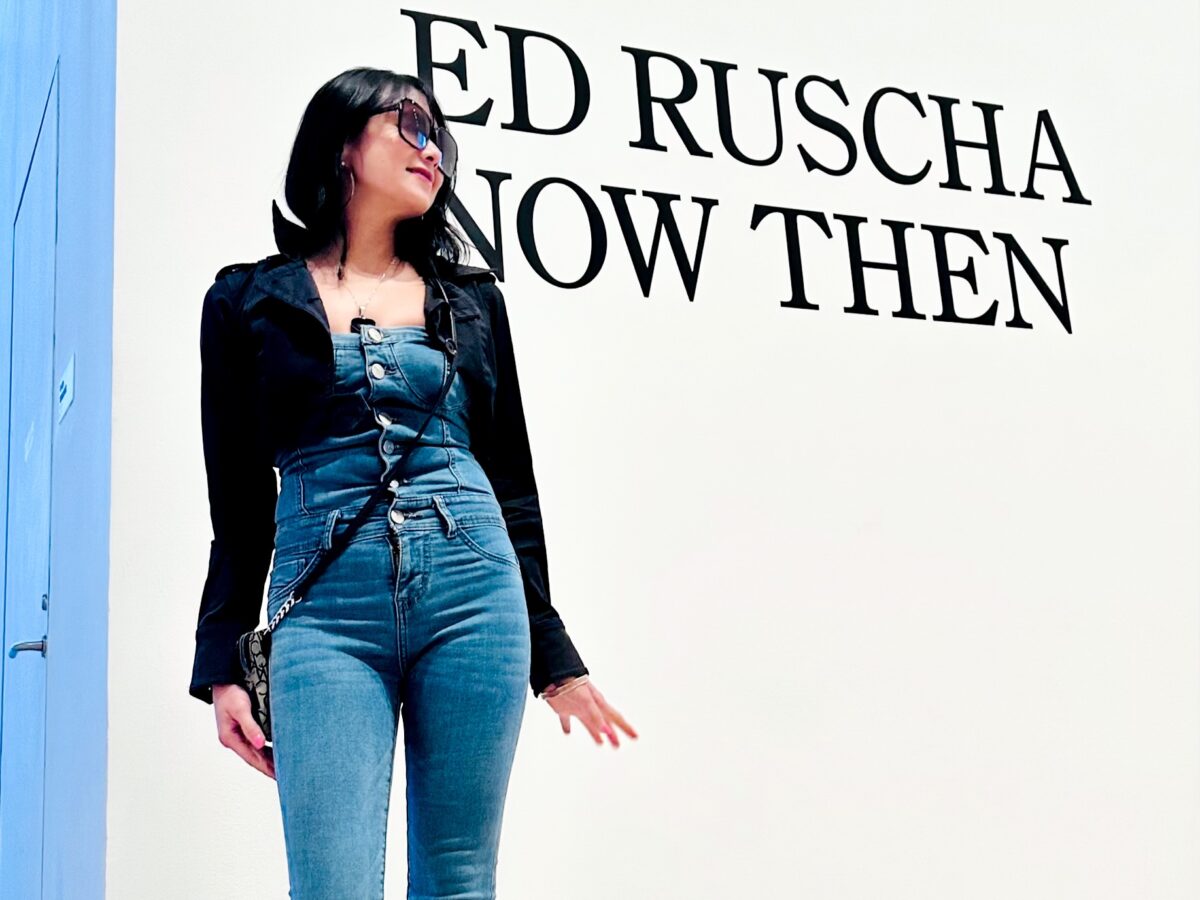
I wasn’t captivated by the romance of Paris or London. I love visiting, but I’d rather be in L.A. I’m interested in glorifying something that we in the world would say doesn’t deserve being glorified.
CalArts
In 1956, right after high school, Ed Ruscha left Oklahoma and traveled west to Los Angeles. He had first come here with his parents when he was fourteen and saw it as the new frontier as described in Steinbeck and Kerouac novels. He said everything about L.A. appealed to him, “the palm trees, the architecture, the sunsets, the weather, movies, jazz.. ”
He enrolled at the Chouinard Art Institute (now CalArts) to study commercial art and graphic design. His father, an insurance auditor, was not impressed at the choice but became more supportive when he read in The Saturday Evening Post that the school was a training ground for Walt Disney, and many students became successful animators for the studio.
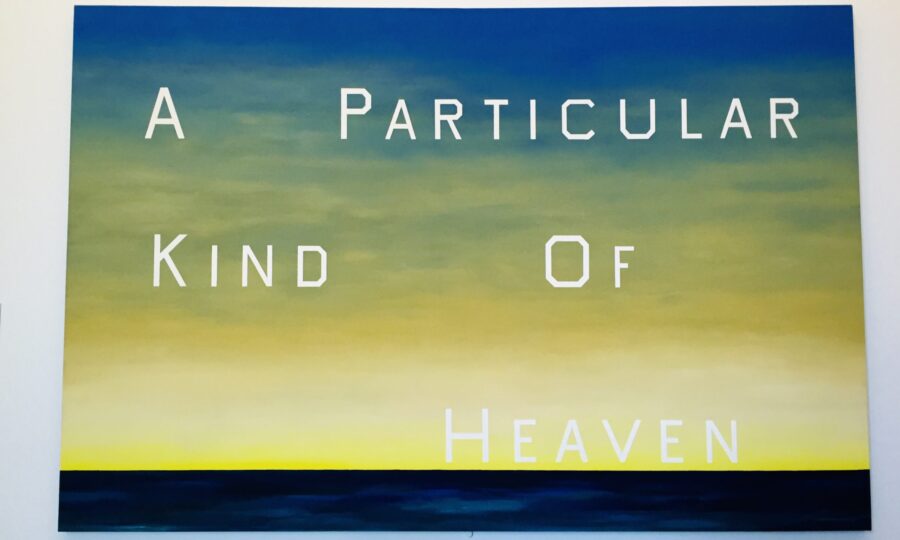
A Particular Kind of Heaven(1983), SFMOMA – “I was raised with the Bible Belt mentality, and by coming to California, I came out of this dark place and unlearned a lot of things I’d been taught.”
One of his teachers, Robert Irwin, would pioneer the L.A.-based Light and Space Movement. In addition to focusing on perception – optical art and geometric abstraction – it explored the use of new materials, such as glass, resin, fluorescent lights and reflective materials. They were the first to experiment with site-specific installations meant to be multi-sensory experiences.
In his early days at Chouinard, Irwin taught watercolors and had a dramatic way of preparing his students in his classes. They would have to cover a stiff backboard with layers of tape and mount wet paper on top to make it stiff and bouncy like a drum. It helped take the anxiety out of facing a blank canvas. “He had a way of softening your thinking, embellishing this idea of free-form thought, not to worry so much about what you’re doing, letting it evolve,” remembers Ruscha.
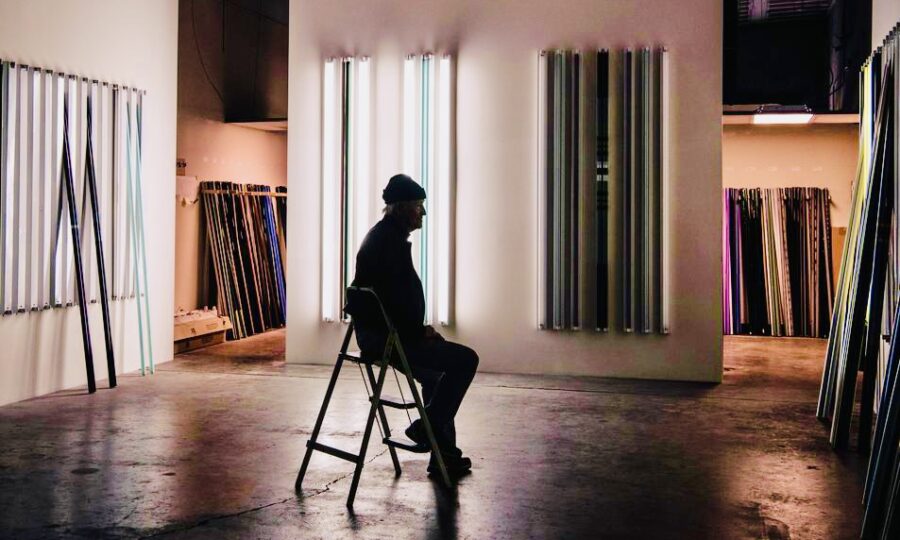
The late great Robert Irwin in his San Diego studio – he was another quintessential artist and contributor to the city’s evolving art scene.
Word Paintings and Photography
That same year, Ruscha bought a twin-lens reflex camera for his classes. He worked a couple of jobs while attending college – for a printing press as a typesetter and for a mail-order company where he personalized gifts. As the contributing editor for the student publication Orb, which the Society of Graphic Designers founded, he was exposed to avant-garde poetry, fiction and Dada-style elements.
His penchant for words and printing started early. He drew cartoons and became a newspaper boy for the Daily Oklahoman in elementary school. In college, he developed a keener sense of typography and began incorporating it into his drawings and paintings.
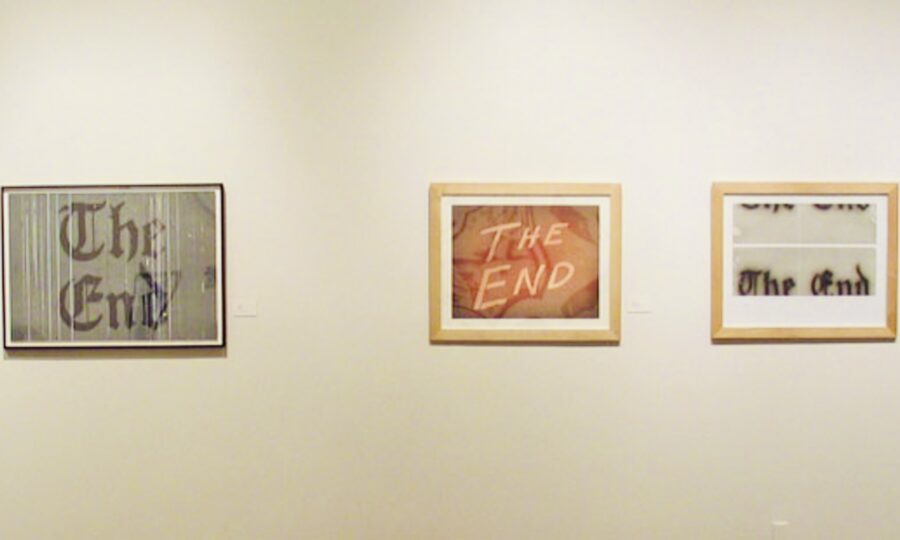
The End (1991), MoMA – Ruscha uses elements – an Old English font and a split screen image – as an “illustration of an out-of-sync mode.”
In 1959, he came across Robert Frank’s The Americans. With a Guggenheim Fellowship grant, Frank traveled from Switzerland and took over 28,000 photographs from all over the U.S. The book’s exploration of American people – old and young, poor and not poor, Black and white, civilians and servicemen – is a photojournalistic look at everyday life across the country. It had a profound effect on Ruscha, “It was like opening a book laced with dynamite. No one had ever told the story of America in such a way.”

Robert Frank, Trolley, New Orleans (1955)
He began taking pictures of ordinary objects, people and places. Because he often traveled between Los Angeles and Oklahoma, he photographed the places he drove by. Although he never really thought of photography as his medium, he liked the sense of documentation and loved the romance and adventure of being on the road.
The First Pop Art Exhibition
After graduating, Ruscha worked as a layout artist for a year before committing fully to making art. He traveled through Europe and New York, took hundreds of photographs and experimented with oil painting before returning to Los Angeles.
In September 1962, the Pasadena Art Museum curated an exhibit entitled New Paintings of Common Objects. Presenting eight artists, including Roy Lichtenstein, Andy Warhol, Ruscha as the youngest, and his Oklahoma classmate, John Goode, it was the very first museum survey of the emerging Pop Art culture anywhere.

Actual Size (1962), LACMA
Just that summer, Warhol had debuted a solo exhibition of his Campbell Soup Cans at the Ferus Gallery on La Cienega. The following year would see a number of follow-up Pop Art exhibitions, including a Marcel Duchamp retrospective, again at the Pasadena Art Museum, Warhol’s Elvis and Liz paintings, My Country ‘Tis of Thee at the Dwan Gallery in Westwood, Six Painters and the Object and Six More at LACMA, and Pop Art, U.S.A. at the Oakland Art Museum, with the last two also featuring Ruscha’s work.

Andy Warhol’s Campbell Soup Cans – it was L.A., not his hometown of New York, that gave him his first solo show.
In addition to launching many young artists’ careers, Ruscha and Goode among them, these exhibitions bolstered L.A.’s reputation as the new setting for contemporary art. It soon replaced San Francisco as the west coast center for artists and became a powerhouse where important art was being made, exhibited and sold.
His First Solo Exhibition
Soon enough, in May 1963, Ruscha would hold his first solo exhibition at the Ferus Gallery. Visitors were greeted with the now-iconic Large Trademark with Eight Spotlights (1962). It was a culmination of the elements of mass media, advertising, graphic design, Hollywood and movies that inspired him and would continue to use. The format of a logo superimposed on a three-dimensional angle would also remain prevalent in his paintings.
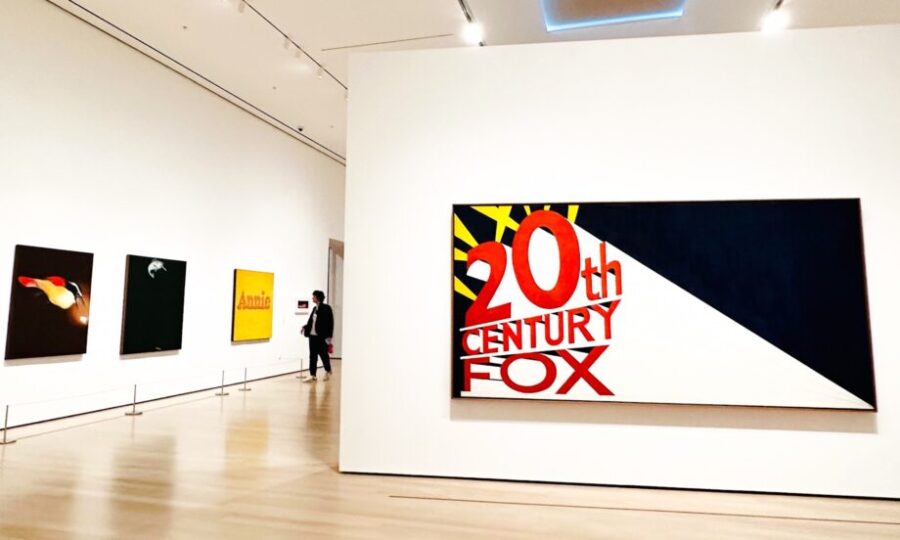
Large Trademark with Eight Spotlights, The Whitney
Actual Size, which was first shown at the Pasadena Art Museum, was also on display. It features a can of Spam, painted true to scale, seemingly exploding and speeding across the canvas. On the top half is simply the word SPAM, oversized and painted exactly like the logo. Measuring 71 x 67” with its attention-grabbing graphics, it’s meant to mimic a billboard ad.
Annie (1962) and Noise, Pencil, Broken Pencil, Cheap Western (1963) adopted his now-ubiquitous format – large scale, simple background, halved composition, recognizable subject and captivating type setting. In Annie, it is the comic title lettering he reproduced. In Noise, it is the cover of the October 1946 issue of Popular Western magazine.
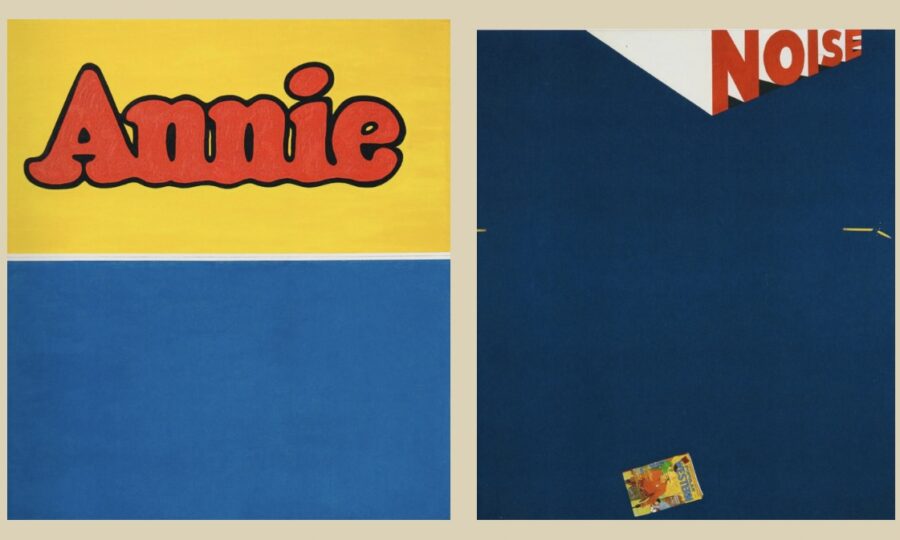
Annie, private collection and Noise, VMFA
He also reworked one of his paintings, Oof (1963), for the show. His love for comics is evident here and he likened it to painting sounds. Together with Smash (1962), they were among his first word paintings and they ignited the era of words and language in visual arts.
Metropolitain, painted in Paris in 1961, was displayed on the gallery’s storefront window as if a public sign and again a connection to commercial advertising. He had seven paintings on view and six sold – a remarkable debut, especially for such a young artist.
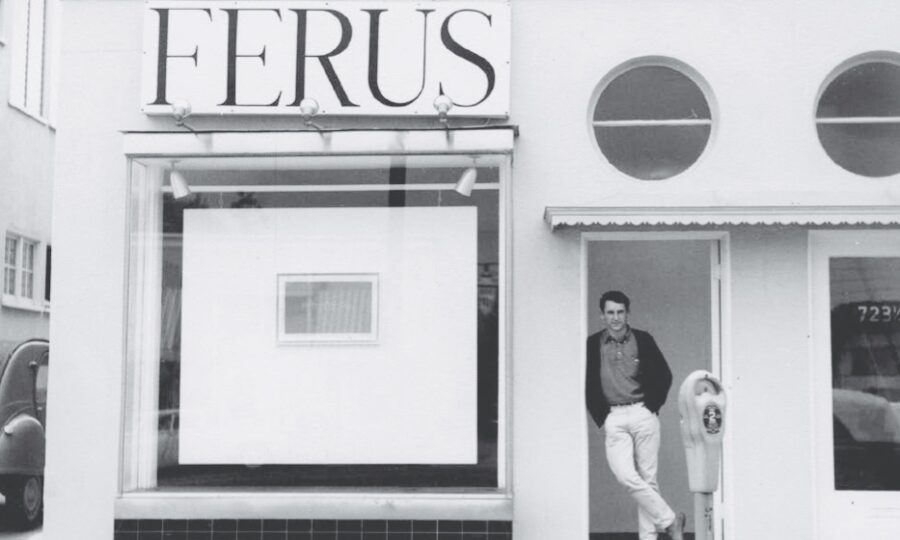
Ruscha at his exhibition (1963)
Made of LA
In 1965, LACMA opened to the public, the largest art museum west of Chicago. Ruscha began to paint it the same year. Provocative when it was first exhibited, Los Angeles County Museum of Art on Fire (1968) is an aerial view with the rear of the Ahmanson Building in flames. It was early in his career and he was very pessimistic about the art world in general. Back then, contemporary art was largely absent from museum walls. It quickly became a Pop Art icon and has even gained an eerie cultish resonance since 2020 when the buildings were actually demolished to make way for a new museum complex.
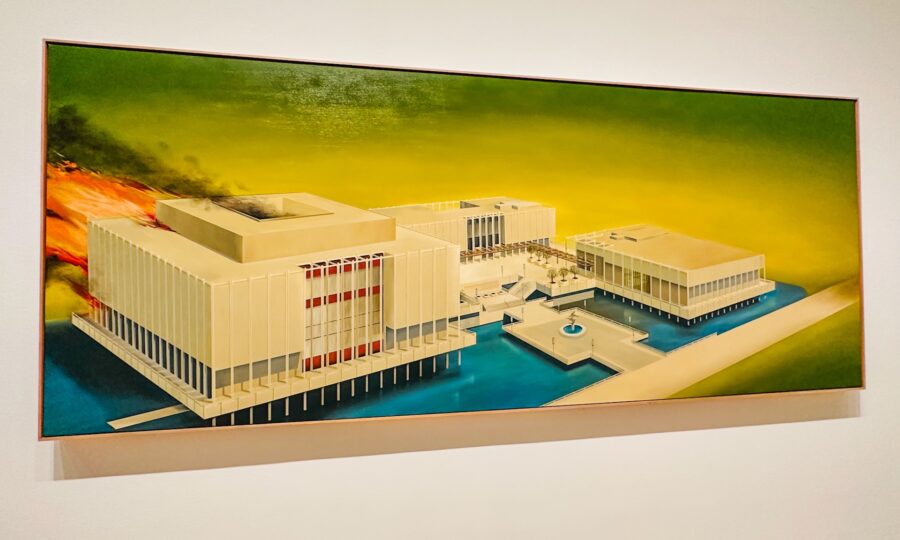
LACMA on Fire, MoMA
As evident in the 20th-Century Fox painting, Ruscha’s art is influenced by the movie industry and its cinematic elements, and he finds many of his inspirations from the city. One of his earlier studios had a view of the Hollywood sign from its window. If he could see it clearly, it meant the air was good enough to go outside. If he couldn’t or if it was blurry, then the smog was too thick. In 1976, he was invited to create a billboard for the city and painted the sign in reverse the way drivers see it in the rearview mirror. He had been photographing, drawing and painting the sign through the smog, rain or shine in various forms and pigments.
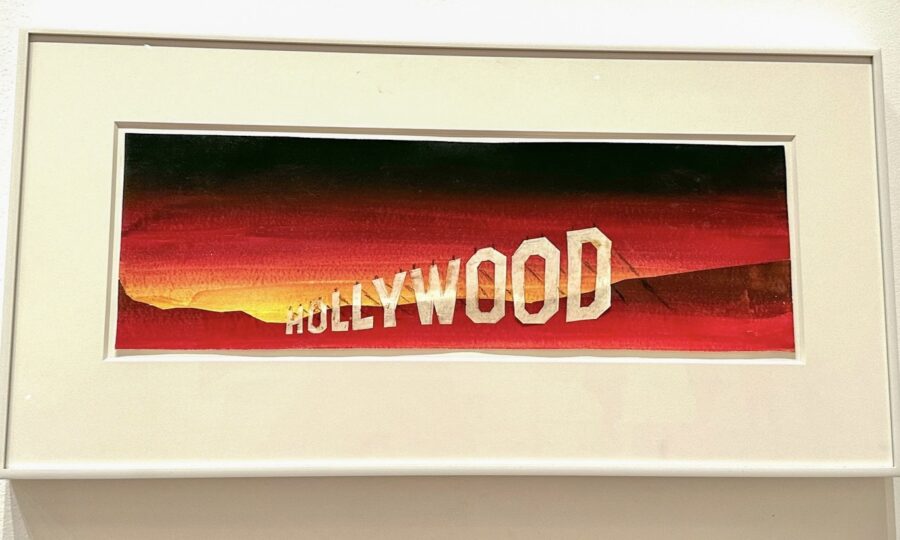
Study for Back of Hollywood (1977), MoMA
In 1976, Ruscha built a house to use as a retreat near Joshua Tree National Park. Soon the mountain ranges on the horizon of the Mojave Desert started appearing in his work. Words and landscapes, always central to his art, explore contrasting themes. He also began to play with palindromes like in Tulsa Slut (2002).
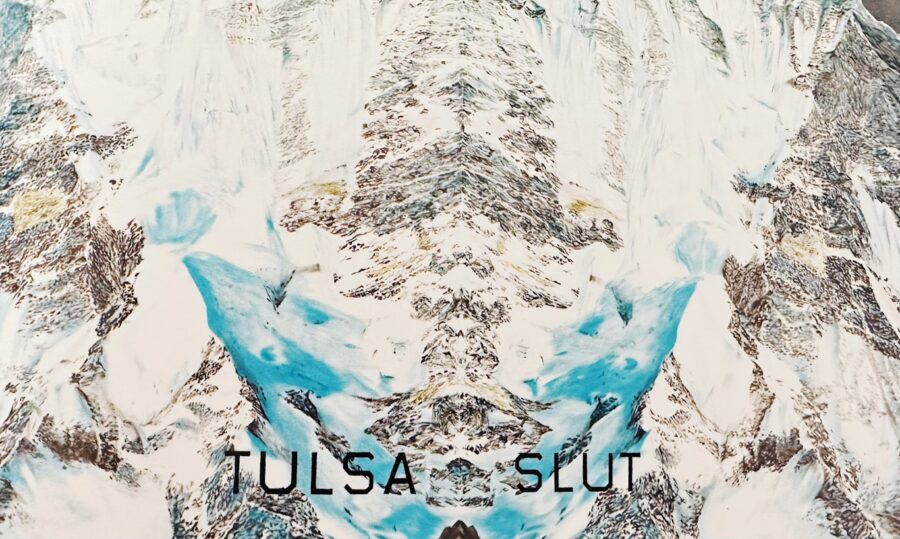
Tulsa Slut, MoMA
Combining word painting and aerial views, Wen Out for Cigrets N Never Came Back (1985) is superimposed on a grid of urban lights. It uses a font he had designed himself. Boy Scout Utility Modern is simple and easy to read, almost amateur, something you’d see on homemade signage, he explained. He repeated this background and typography on a series of paintings of colloquial terms, including Mean as Hell (2002) and Was a Guin Mon? U Dig Me? (1985).
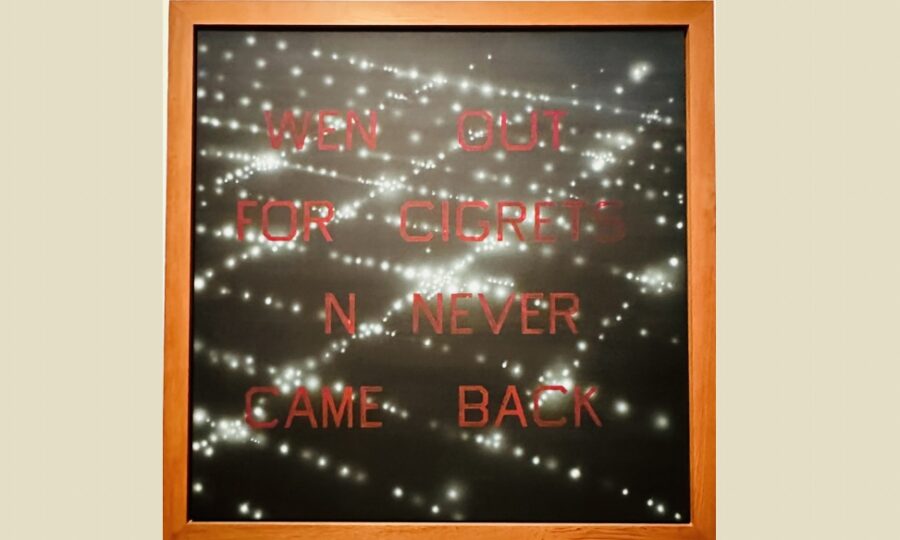
Wen Out for Cigrets (De Young Museum) refers to an American trope in which the father goes for a smoke and never returns – “Sometimes I feel like I’m doing book covers for mysterious stories.”
Various Small Books
Naturally, Ruscha had to stop for gas on his drives between L.A. and Oklahoma, which he made five to six times a year. After going from painter to printmaker to photographer, he undertakes a new medium in self-publishing Twentysix Gasoline Stations (1963).
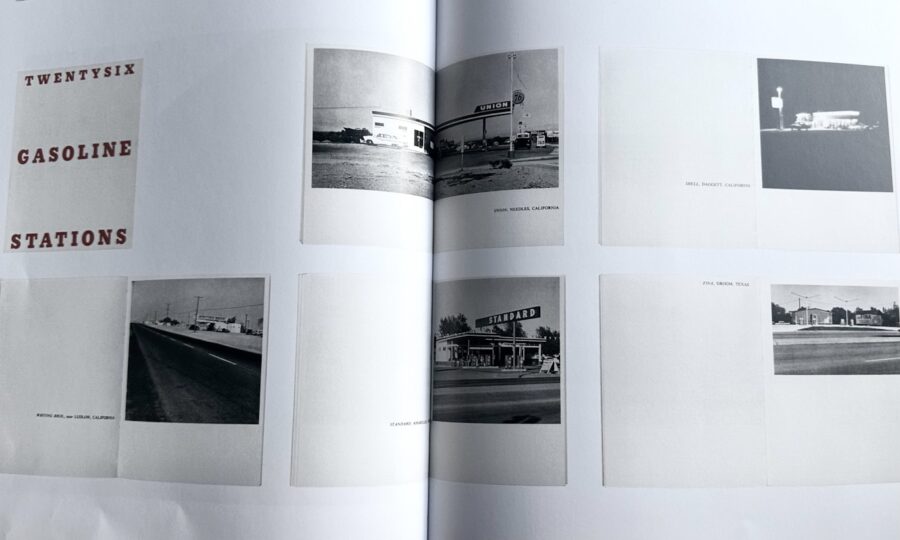
Twentysix Gasoline Stations
Again taking from the Steinbeck-inspired 1940 John Ford film, The Grapes of Wrath, which told the story of Oklahoma migrants traveling west on Route 66 while also using Robert Frank’s medium and purpose in The Americans, Ruscha likened himself to a reporter taking the news from one place to another in the form of photographs.
Although nothing particularly picturesque is in the pictures, there was something about the simple and historic architecture of gas stations spread out on the open road of the wild, wild west he found appealing. But there was something reproving in the subject matter. California’s car culture, commercialization, gasoline consumption and its environmentally devastating effects paint a more unromantic picture of this often star-fabled place.
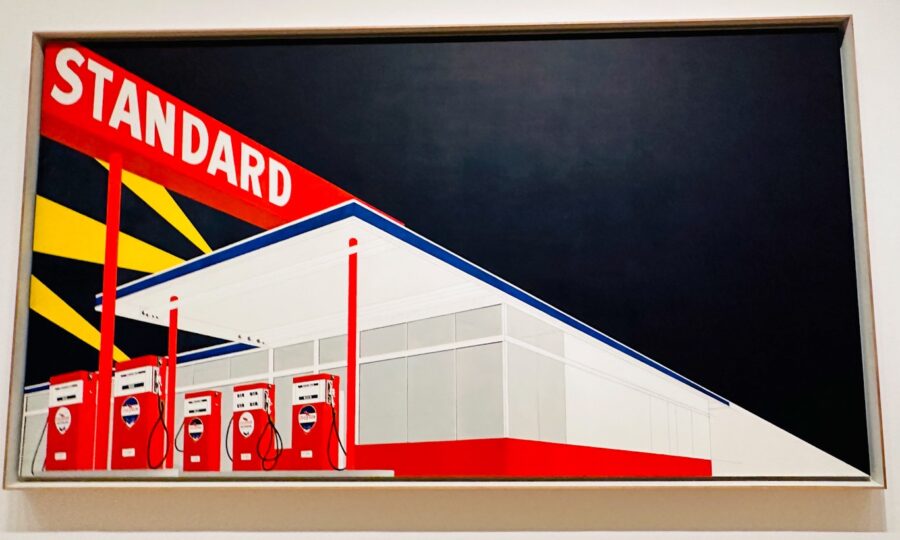
Standard Station (1964), MoMA – Ruscha often used the photographs he took as subjects for his sketches and paintings.
The book itself is simple – black and white photographs of exactly what the title suggests with minimal documentation. Rejecting the traditional mode of pricey, handcrafted, limited-edition livre d’artists, Ruscha opted for a commercial printing press and sold the book for $3 each. It was rejected by the Library of Congress, which deemed that it could not be considered a book, so he took out an ad on Artforum and sold them at locations in L.A. and New York. Today, libraries can’t shelf them because they kept getting stolen and they are worth upwards of $15,000.
In 1965, Ruscha followed up with Some Los Angeles Apartments, a series of photographs of residential structures designed in quaint modernist styles with the building names in even quainter fonts. The 38 examples portray everything from walk-ups to high rises, from the San Gabriel and San Fernando valleys to Long Beach and Malibu. Numerous photographers have followed suite with books, exhibitions and collections showcasing L.A.’s unique vernacular architecture.
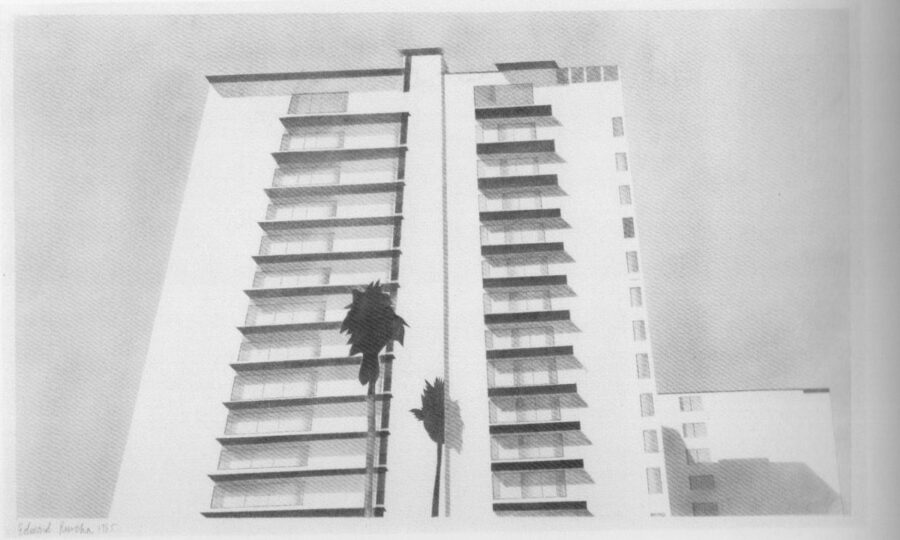
Wilshire Boulevard (1965) – graphite drawing from a photograph
One Sunday morning, on a helicopter ride over L.A., Ruscha saw the built environment of the city from a different perspective. Again, he takes a seemingly banal subject in Thirtyfour Parking Lots (1967), but from a more oblique bird’s eye view, and captures the sense of a desolate place – the large parking lots largely empty.
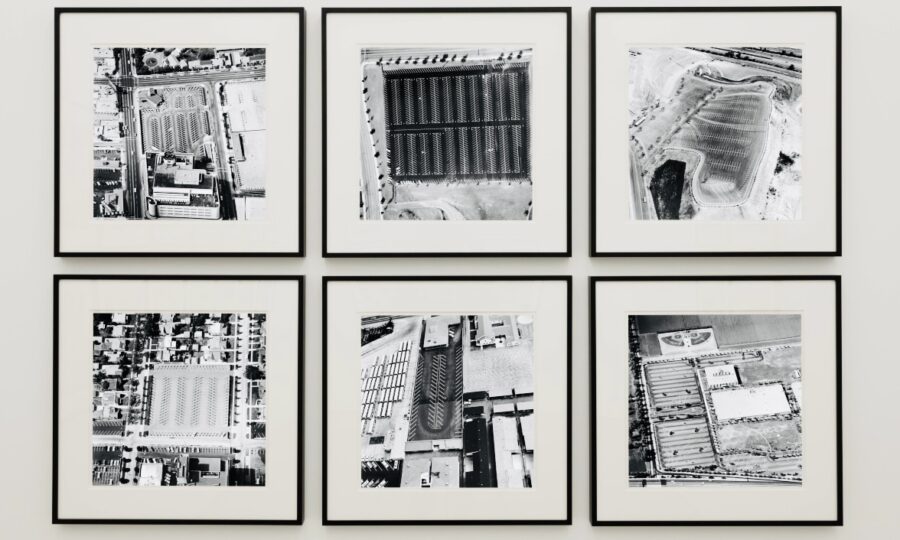
Parking Lots photo exhibit, Yancey Richardson Gallery
Also unmissable from the air, Nine Swimming Pools and a Broken Glass are closer-up photographs portraying another quintessential element of the city – the bright blue pools contrasting with the concrete jungle. In Real Estate Opportunities (1970), he presents tracts of lands found for sale all over L.A. County, primarily empty and seemingly rural – a stark contrast to the urban landscape.
Paying homage to one of the things that drew him to L.A., A Few Palm Trees (1971) came from a scrapped project originally titled Seventeen Hollywood Palm Trees. The finished book contains fourteen stripped-down black-and-white photographs with cross-street addresses for reference.
It’s not just capturing the buildings that we’re all so familiar with but the curbs and the drainage channels and power poles and everything else — municipal concrete — that makes the whole study worthwhile. Because you can go back and compare: ‘Oh, there’s that tree or Mexican fan palm and look what size it is today.’ I just look at it like: ‘This is our destiny.’
Since then, his books have spun countless small and random books from generations of artists. They’ve opened up new avenues for artistic expression and pushed the boundaries of conceptual and visual arts. Books were elevated to the status of art objects worthy of exhibition and contemporary art was seen as a more intellectually-driven approach.
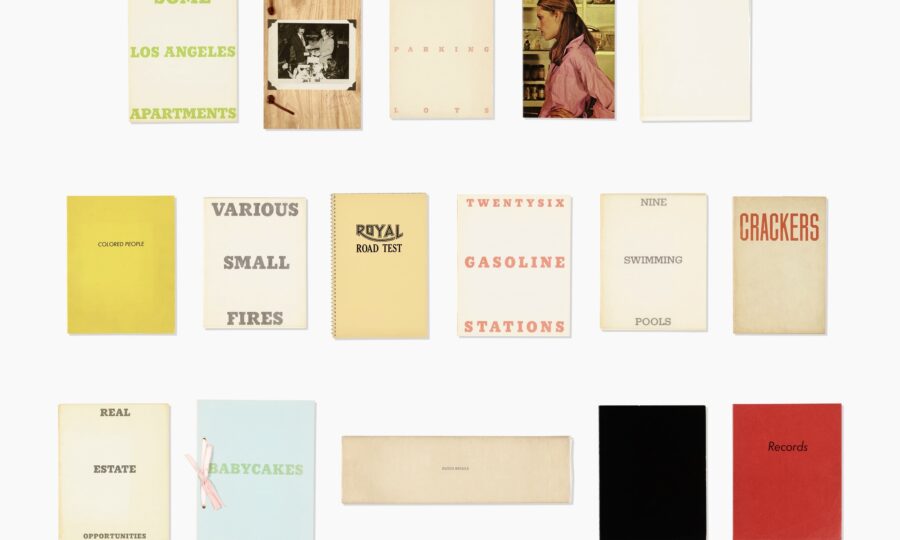
Ruscha’s photobooks
Every Building on the Sunset Strip
Between 1963 and 1978, Ruscha published 16 books. But none would turn out as ambitious a project as Every Building on the Sunset Strip (1966) will become. While attending a Doors concert at the Whiskey a Go Go, he noticed the concentration of neon signs and music posters amidst the whirring, crowded nightlife.
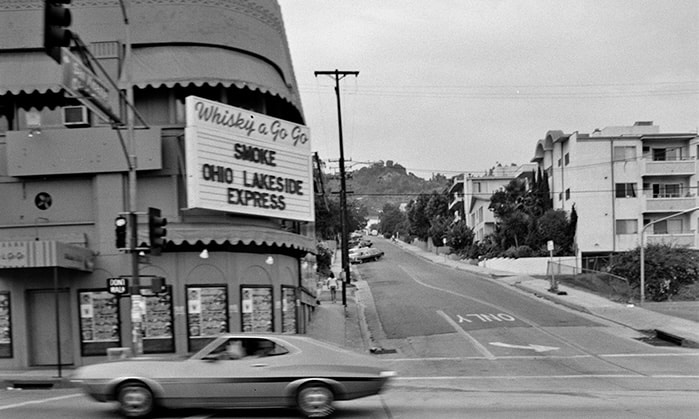
Whiskey a Go Go on Sunset Strip (1974)
So again on a Sunday morning, he mounted a 35mm motorized camera on the back of his pickup truck. He had initially tried photographing the street on foot before developing a more efficient, mechanical way. He pointed the camera at a right angle and fitted it with a roll of film, taking thousands of frames continuously (think of it as the physical precursor to Google Street View). On the back of his slow-moving truck, he put a sign saying, “Please pass.”
He photographed the mile and a half constituting the Strip in less than two hours. He published it in the form of a leporello, a fold-out accordion-style book measuring 27 feet that portray a linear view of literally every building, both the north and south side, on the Sunset Strip.
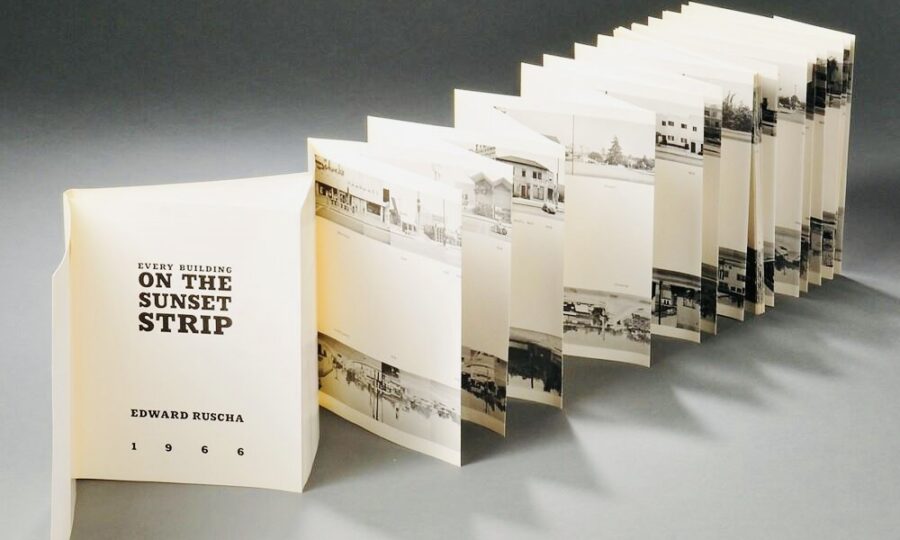
Every Building on the Sunset Strip
He would go back to continue photographing the entire length of Sunset Boulevard – 26 miles from downtown to the ocean. Soon, other streets followed, including Wilshire, Melrose, Hollywood, Pico, Sepulveda and the Pacific Coast Highway. He also photographed “suites” of streets of certain neighborhoods, including Chinatown and Silver Lake. He has kept returning to the same streets to document their changes.
In 2004, he used colored film for the first time. He tried a digital camera but didn’t like the results, so he switched back to film. His method is systematic and he has basically used the same formula with the specific height of the tripod, the length of the lenses, the depths of field, the frames per second, and the speed of the truck, making minor adjustments as needed.
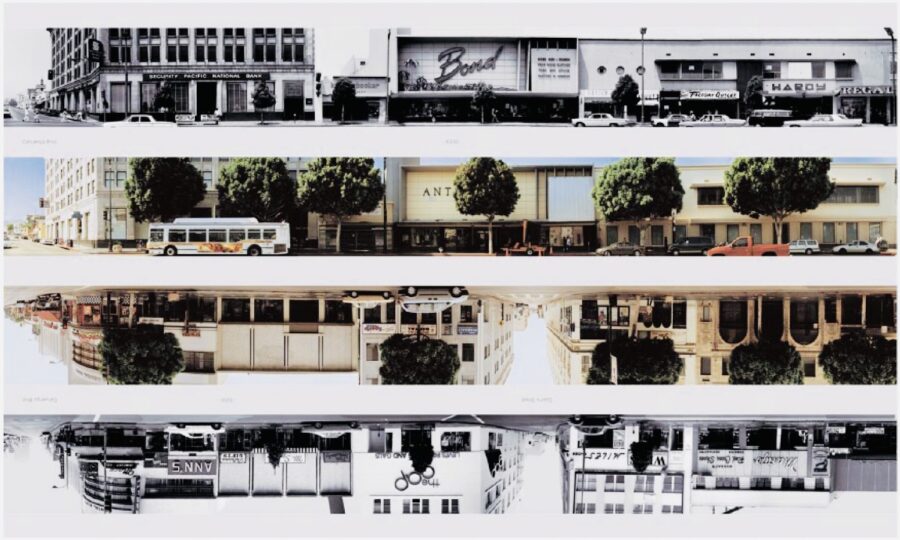
Then and Now: Hollywood Boulevard 1973-2004 (Gagosian Gallery) – a photo book with north and south side panoramas taken at interval
The Streets of Los Angeles Archive
Today, what we have are over two million images from photographs, negatives and contact sheets taken over a period of almost six decades that document the history of the streets of Los Angeles.
We see a constantly evolving city through periods of urbanization, globalization, geopolitics and immigration. Buildings have been torn down and replaced, boundaries have shifted, signage translated into different languages, landscapes razed for luxe residences, neighborhoods gentrified, businesses changed, downtown was revived, graffiti has lessened, traffic has gotten worse but the smog has actually improved, streets were cleaned up, and palm trees grew – everything from incremental to turn-of-the-century transformations.
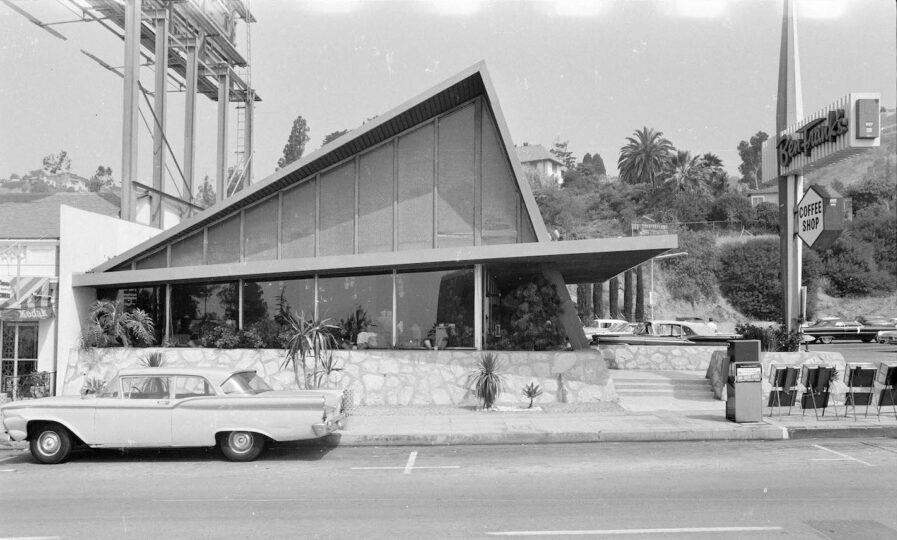
Ben Frank’s (1966) on Sunset was an A-list hotspot (it’s now a Mel’s).
The Strip alone was a prime setting for social upheavals. It saw through the Civil Rights movement and antiwar protests. Sometimes, the protests turned into riots. In 1967, it became among the first places to hold pro-LGBTQ demonstrations. In the 70s, it became an epicenter for rock and roll. There have always been signs, billboards and posters everywhere. And they help tell the story.
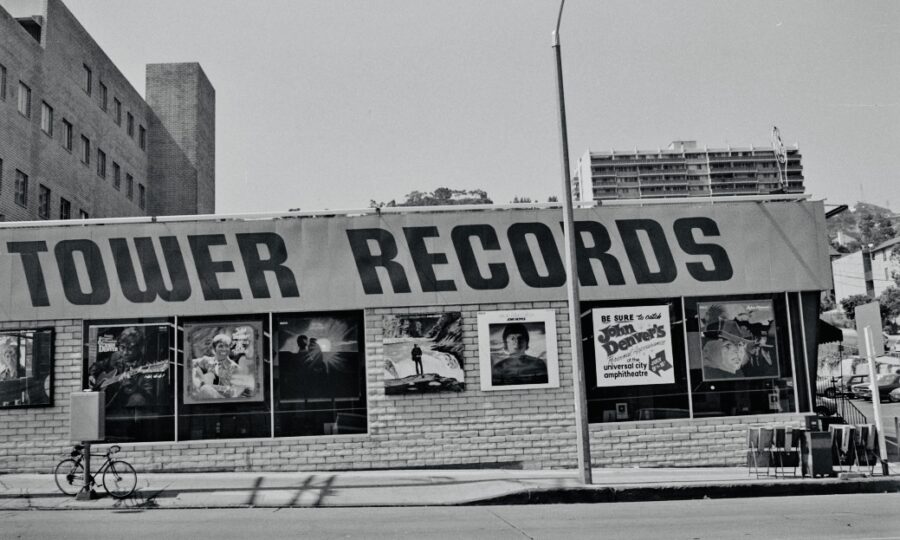
Tower Records (1973) closed in 2006 and reopened as Supreme last year.
The collection is so vast that even Ruscha and his team have not seen most of the images. In 2012, the Getty Research Institute began the process of acquiring and digitizing them. It has also built a dynamic interface to map out and identify every building and subject, past and present, in each image so users can view and search through them.

The entrance to Chinatown on Cesar Chavez Av. (2007)
You can type in “coffee house” or “churches” or “billboards” and see all the corresponding images. You can ride down the streets virtually. The street-level view also gives it such a tangible and human aspect. You can trace what has changed and what hasn’t. It’s a huge project and only a fraction – about 120,000 photographs from Sunset and Hollywood – have been uploaded so far.
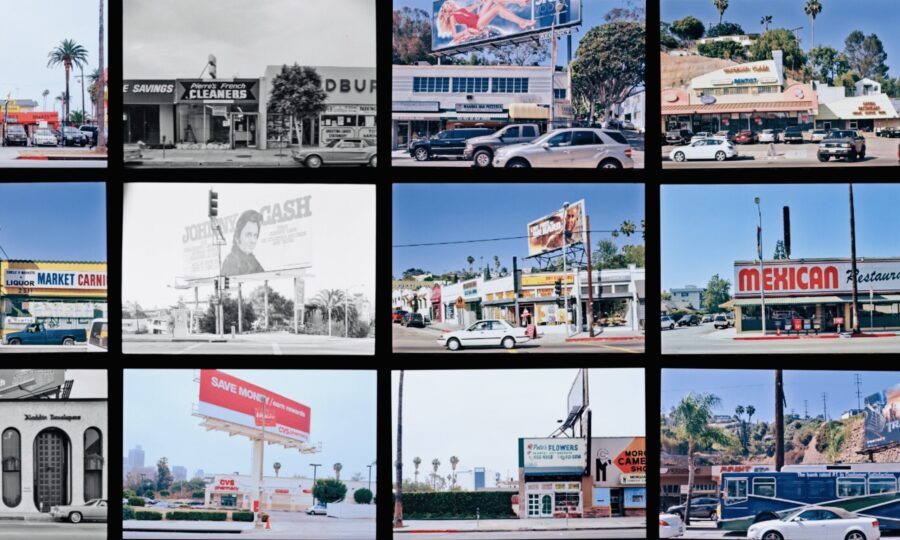
A collage of signage and billboards
Still, no other project that documents the history of a city comes close to the scope of Ruscha’s archives. And he plans to continue, “It’s a living organism, there’s no cut off date on it. For that reason, it’s got vivid possibilites.” He was always seen as the quintessential L.A. artist. Now we feel he deserves a more noble title – the artist-historian laureate of our city, perhaps.
Earlier in his career, Ruscha would often disregard the importance the city had in his work, claiming he could have easily ended up in New York or Chicago or Minnesota, and his art could have been the same. Back when he began Every Building on the Sunset Strip, he told an interviewer, “Being in Los Angeles has had little or no effect on my work, I could’ve done it anywhere.” That was then. Of course, he never says that now.
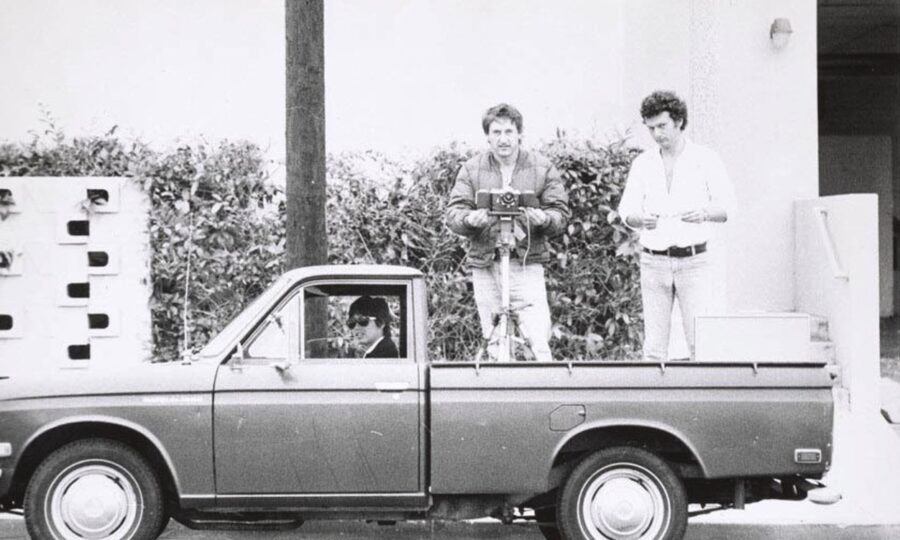
Ruscha and assistants (1975)