
Art and Architecture
No other name is more synonymous with avant-garde architecture than Frank Gehry’s. Self-described as an outsider from the beginning as he grew up amidst anti-Semitic sentiments in Ontario, Canada, he learned to thrive as one early on. His grandfather owned a hardware store, and his grandmother would bring home nuts, bolts, and wood scraps for the stove. Together, she and the young Gehry would spend hours building imaginary cities on the kitchen floor, connected by intricate causeways. His father liked to draw and encouraged him to do sketches. His mother took him to art museums and the symphony. All these art forms will find themselves interlaced in his architecture later on.

Rough sketches
In 1947, the family moved to Los Angeles. Gehry worked as a truck driver during the day and took college classes at night. But even here, they experienced prejudice. During his second year of architecture school at USC, his professor told him he should give it up. It was then that he changed his last name from Goldberg to Gehry at his wife’s insistence. After graduating from USC, he went on to study city planning at the Harvard Graduate School of Design.
He returned to Los Angeles to work for one of his mentors at USC, Victor Gruen, who was an innovator in urban revitalization projects and outdoor mall design. Gehry was put in charge of project budgets and quickly became the housing expert. His team included forward-thinkers who shared his interests in art, design, and social construct. But always the outsider, he was uncomfortable at doing presentations for clients and with corporate structure overall. He began to take independent projects with another USC colleague, Greg Walsh, who he would establish Gehry Partners with. The Steeves House (1958) was their first residential commission. The flat roof and horizontal lines were reminiscent of Frank Lloyd Wright’s Prairie Architecture. The design included open spaces and Asian influences, characteristics of modern housing in Los Angeles.

Venice lofts (1981)
But what set Gehry apart was the ever-present roughness to his approach. He termed it “cowboy construction,” using small-scale builders to accommodate tighter budgets. He was a young architect then, designing for lower-income clients. At that time, new developments were spreading throughout the city and beyond. He saw these tract homes in the suburbs and the outskirts of Los Angeles. In the early stages of construction, they were just exposed frameworks. “There was a beauty to the houses before they were covered up and I remember thinking that the artists were telling us that perfection was not necessarily the right way to look at things. The roughness was interesting to me, in terms of spontaneity of the aesthetics. It had a humanity to it.” They not only inspired him, but gave him ideas on how to be more resourceful. He began to experiment with less expensive materials. The use of bare plywood, corrugated metal, and chain link fencing would end up contributing to the uniqueness of his designs and the resourcefulness he would apply throughout his career.
Arts and Artists
One of the biggest criticisms of Gehry’s architecture is it looks too much like art and sculpture. To Gehry and his supporters, this comes as a compliment. After all, he studied art before architecture. “If I have a big envy in my life, it’s about painters. I wish I was a painter. I’m fascinated with that moment of truth. There’s the canvas, it’s on your easel, you got a brush and a palette of colors, and what do you do? What’s the first move? I love that dangerous place.” A college class on drawing and perspective was the turning point. And it was his ceramics professor who suggested he become an architect.
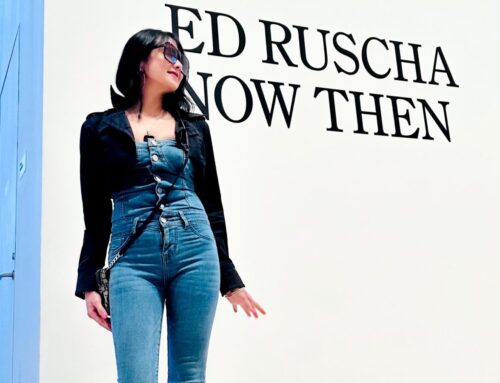
Coincidentally, the art scene in Los Angeles was exploding beginning in the 1950s. The Ferus Gallery and LACMA were becoming centers for modern and contemporary art. “It was like an intellectual candy store. But the architects were not talking about poetry and music and Michaelangelo. In art, there were no rules. There were no you can’t do this.” Gehry explored the works of Henry Moore, Jasper Johns, and the Cubists. He began to design museum spaces for exhibitions. He became friends with Ed Moses, Larry Bell, Chuck Arnoldi, and Ed Ruscha. Kazimir Malevich’s Suprematism, which focused on geometry; Robert Rauschenberg’s “combines,” which used found materials; and Richard Serra’s large-scale, site-specific, walk-through sculptures are all distinctly evident in Gehry’s architecture.
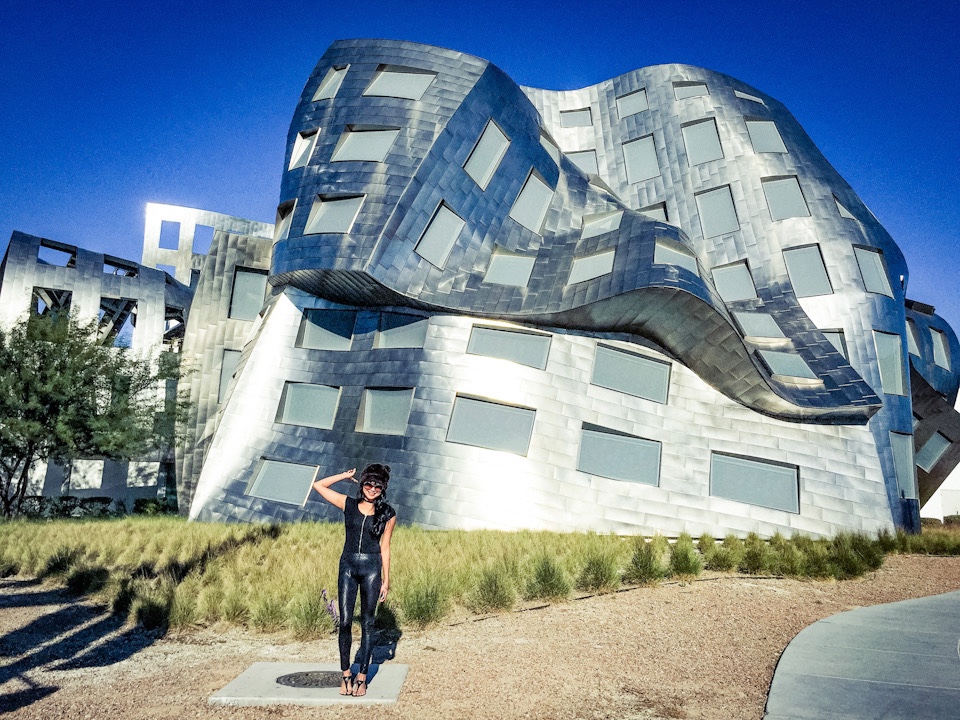
Keep Memory Alive Event Center “What does the building mean? It symbolizes hope.”
Architectural Inspirations
Gehry’s works also pay homage to many architects that came before him. When he was 16, he attended a lecture at the University of Ontario. The speaker was none other than Alvar Aalto, the Finnish architect who pioneered Functionalism and had world-famous designs for furniture, lamps, and jewelry. But Gehry wouldn’t know his name until he himself became an architect and checked the school records. What he does remember is that “the work attracted me because it was humanly accessible.” He would spend time designing the exact same things – furniture, lamps, and jewelry. In college, he was exposed to Raphael Soriano, who helped define California’s Mid-Century Modern homes. Gehry has always taken such inspirations from the local landscape – beach bungalows, southwest pueblo architecture, open floor plans, and integrated outdoor-indoor spaces – to create a sort of nouveau California style.
Then there’s Le Corbusier, who was both artist and architect, a master of urban planning, and one of the most influential pioneers of what would become known as Modernist Architecture. There are also traces of Louis Khan, in their poetic aesthetics, in breaking free of traditional façades, and in the juxtaposition of their outer and interior designs. And Antoni Gaudi, whose organic forms and innovative materials have influenced Gehry’s approach to irregular shapes and structures.
Los Angeles
But the most significant influence on Gehry’s architecture is the city itself. He admits that nowhere else in the world would he have been allowed to build what he built here, especially when he was largely unknown. His Santa Monica home is a prime example. While keeping the Dutch-style 1920s bungalow intact, Gehry built a house around it. He made numerous additions using unconventional materials and odd shapes. The mix of angular windows, stripped-down wood framing, chain link fencing, and see-through windows and ceilings was contemporary and deconstructive. The result is whimsical and awe-inspiring with shadows and reflections everywhere. While many of his neighbors hated it, artists and architects lauded it. And as his fame grew, so did the number of the home’s admirers.

Gehry Residence, Santa Monica
Gehry has also been instrumental in reviving the rest of the city. The construction of Santa Monica Place started in the 1970s when he still worked with Victor Gruen, who was the one who suggested that 3rd Street be turned into a pedestrian-only promenade. Gehry envisioned a development of apartments, hotels, and retail – a more expansive version of New York’s Midtown Plaza, another one of his projects with Gruen. It turned a sleepy town into one of L.A.’s premier destinations.
In Venice, Gehry collaborated with the sculptor Claes Oldenburg. The project was for the advertising firm Chiat/Day, who would later become famous for their campaigns for Apple and Nike. The Binoculars Building (1991), as it would be known, was originally a structure designed for another Venice, the one in Italy, to be placed out on a lagoon. While the Italy commission fell through, Chiat/Day felt it was perfect for their offices and the art program they wanted to incorporate together. The result further blurred the lines between art, architecture, and sculpture.
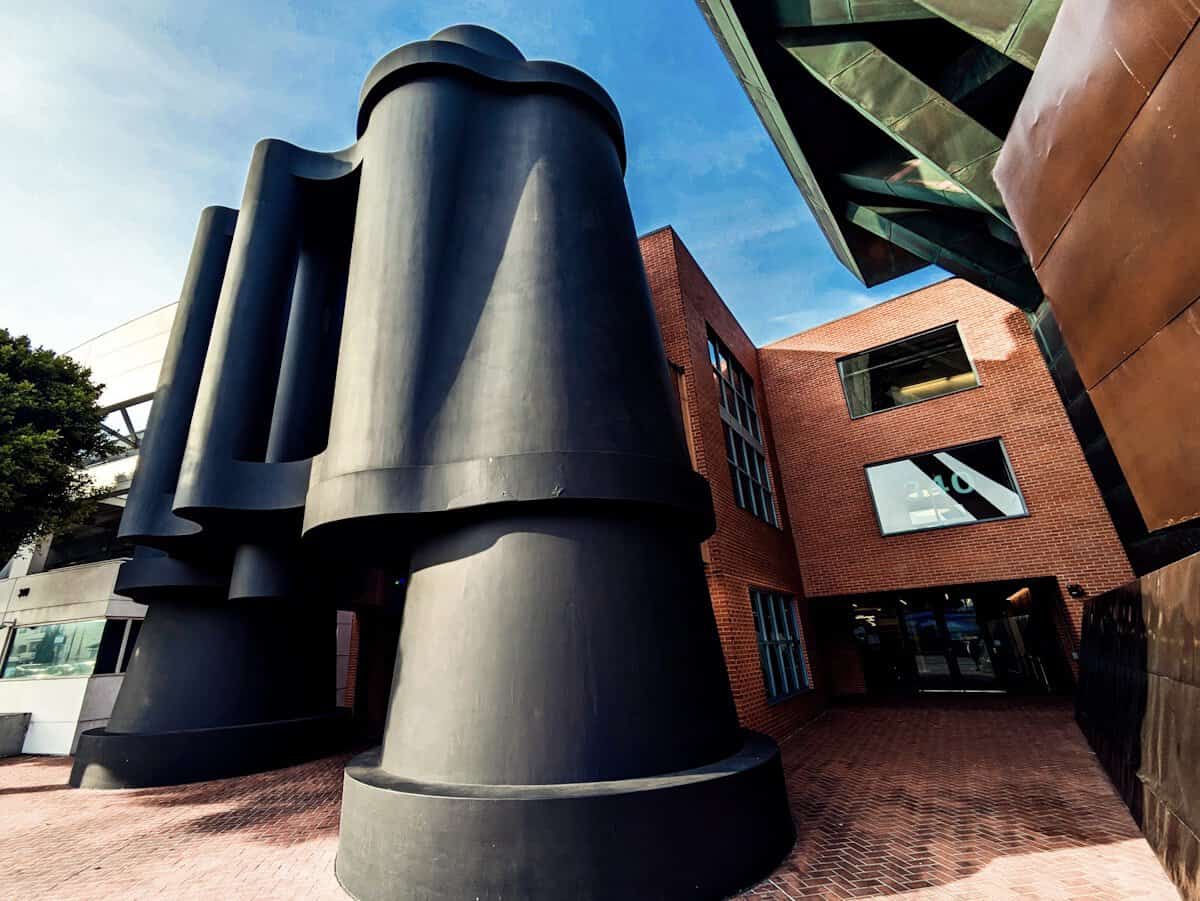
Binoculars Building, Venice
Other unique and successful projects include the Cabrillo Marine Museum (1981), where he was to explore the use of chain link fencing and corrugated metal on a larger scale; the California Aerospace Museum (1984), which was made of sheet metal, stucco and concrete with a real-life fighter plane over the entrance; the Loyola Law School (1985), a blend of classic and postmodern designs); and the Goldwyn Hollywood Library (1986), a modernist building of glass and stucco.
Walt Disney Concert Hall
But no other work would define Gehry’s contribution to L.A.’s architecture than Walt Disney Concert Hall. Inaugurated in 2003, it represents a decades-long relationship with the city’s performance artists. In 1983, he modified a temporary exhibition facility for LACMA. Located in Little Tokyo, the raw space was so successful it was turned into a stage for dancers. The following year, he staged the Olympic Gala at the Hollywood Bowl, which he’s been supplementing with cardboard Sonotubes and fiberglass to improve the acoustics and accommodate the ever-growing audience.

“The shapes of the exterior of Disney Hall are based on sailing. If you look at the front, it’s wing on wing, creating a beautiful space. It’s the two sails and you’re at the helm.“
Remember that classical music played a major role in Gehry’s childhood since the times his mother took him to concerts in Toronto in the 1930s. In 1987, his design was chosen out of 80 other architects for its highly original architecture. The Walt Disney Concert Hall was envisioned to specifically house the L.A. Philharmonic, which has been sharing the stages at the Hollywood Bowl and the Dorothy Chandler Pavilion. It also held the promise to help revive a decrepit downtown and turn it into a cultural and architectural center.
Gehry would take the work even further. His past research and work with sound and music would drive him to create a performance stage with perfect acoustics. And his team’s pioneering work in applying CAD (computer-aided design) and CATIA (computer-aided three-dimensional interactive application) softwares, initially used for airplanes and ships, led to the invention of technology that is now used for designing irregular shapes, non-linear forms, and curving geometry for buildings.
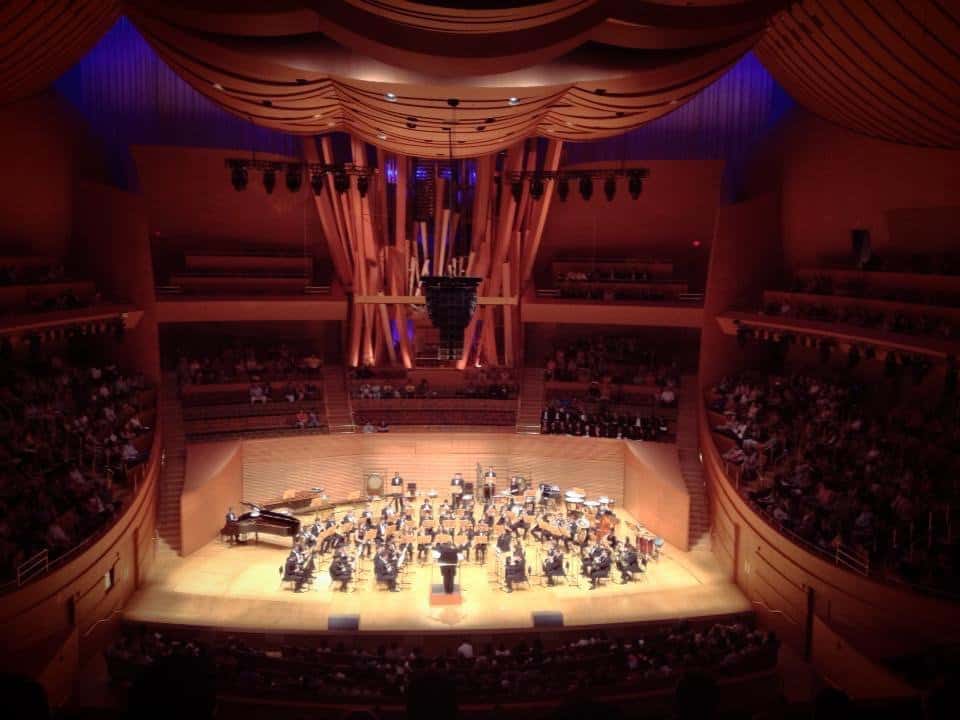
Auditorium/Interior of Walt Disney Concert Hall
That and the result of working with renowned acoustical designers is a 2,000-plus-seat auditorium where you can get pitch-perfect sound from the stage no matter where you’re sitting. Douglas fir is used for the interior paneling to help sound travel to every corner. The exterior is covered with steel panels, each of which is individually shaped and unique. Light and shadows reflect off and the colors change throughout the day. The auditorium, both inside and out, is magnificent and striking. It spurred an artistic and cultural explosion in Downtown Los Angeles, which now includes The Broad next door, the newly-built Grand LA across the street, and an arts district featuring over 50 galleries and institutions.
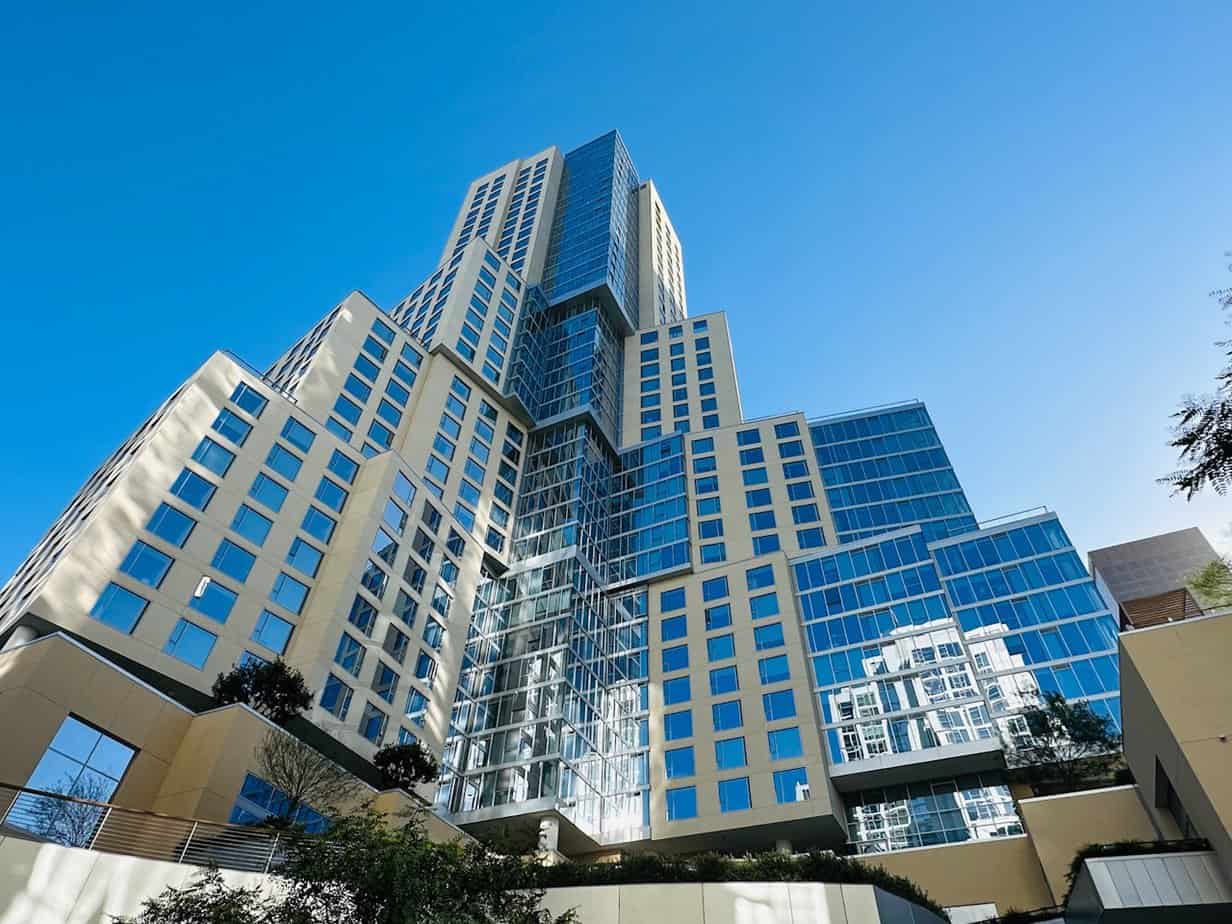
Gehry-designed Grand L.A. residences across from Walt Disney Concert Hall
Gehry would always credit the city itself for giving him both the inspiration and the freedom to build the things he wanted. And in return, we are just as grateful.