
“Of all the major literatures, Arabic is by far the least known by Europeans and Americans, a huge irony given that all Arabs regard the immense literary and cultural worth of their language as one of their principal contributions to the world.”
-Edward Said
Naguib Mahfouz
In 1980, Edward Said’s publisher asked for a list of recommendations of foreign writers, specifically Africans, for translation and publication. On top of his list was Egyptian novelist Naguib Mahfouz. When nothing came of it, his publisher explained, “We decided not to do it. Arabic is a controversial language.”
It was preposterous but unfortunately represented the general prevailing sentiment – that Arabic, whether the language, geography or, in fact, the entire culture, is a controversial subject. At that time, Mahfouz had yet to be awarded the Nobel Prize, he was unknown to Western readers, and Arabic-to-English translations were rare, almost nonexistent.
It’s clear why Said chose Mahfouz, who had been writing for 50 years. While Arabic literature has a rich history of poetry, its novel form is relatively new. But Mahfouz had mastered it in a short time. His writing is reminiscent of Dicken’s London (read Midaq Alley or The Beginning and the End) and Jules Romaine’s epic Men of Good Will (read Mirrors). Mahfouz’s masterpiece, The Cairo Trilogy, parallels Tolstoy’s War and Peace (the occupation of Moscow vs Cairo) and Victor Hugo’s Les Misérables (the theme of revolutions). He and Said had graduate degrees in philosophy, having studied Western doctrine. Mahfouz was a disciple of Henri Bergson – the themes of dualities and time continuum evident in his work, and Said was a follower of Vico, evident in his tireless rhetoric. The Thief and the Dogs echoes existentialism, Zola, Kafka and Camus.
In a single lifespan, Mahfouz’s bibliography compressed the history of the European canon. He was the ideal introduction to modern Arabic literature. But no American publisher would touch him. This changed in 1988 when he received the Nobel Prize. An international demand for his work surged overnight, and his books have been translated into over 40 languages. He remains the only Arabic-language writer to receive the award.

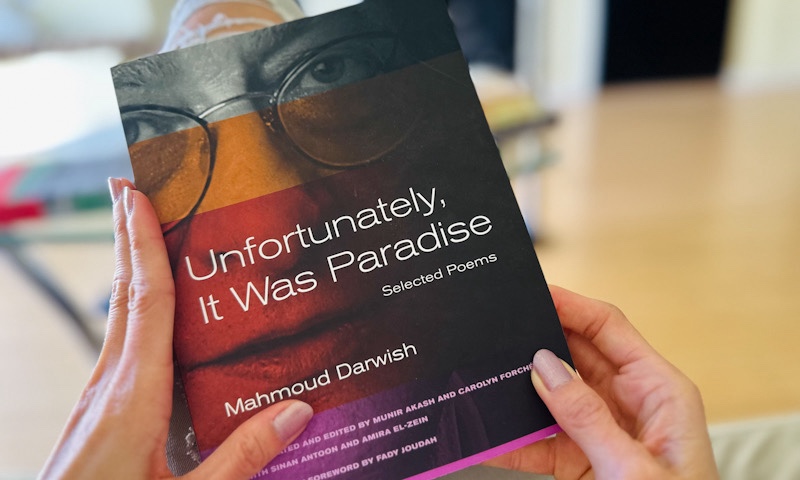
Mahmoud Darwish
“We are captives, even if our wheat grows over the fences
and swallows rise from our broken chains.
We are captives of what we love, what we desire, and what we are.”
-Mahmoud Darwish
Said and Darwish met in 1974, but their shared histories trace farther back – to a homeland that no longer exists. Said was born in Jerusalem in 1935, Darwish in Birweh in 1941, when Palestine was under British Mandate. Both families lost their ancestral homes with the establishment of Israel in 1948. In exile, they turned to literature to forge new lives – Said to teaching comparative literature, Darwish to writing poetry.
In this way, Darwish became the voice of the Palestinian diaspora. Though a paradox that in something as solitary and hermetic as poetry, he captured the collective experience of an entire forsaken people.
“Exile is strangely compelling to think about but terrible to experience,” goes a famed quote by Said. In the beauty of the works of exiled writers, it’s easy to equate them with a tinge of romanticism – from Ovid and Dante to Neruda and Ha Jin. “While it is true that literature and history contain heroic, romantic, glorious, even triumphant episodes in an exile’s life, these are no more than efforts meant to overcome the crippling sorrow of estrangement,” as the quote continues.
Darwish was six when Israeli forces captured Birweh, and he fled to Lebanon with his family. The village was razed to the ground so they would have nothing to return to. It was erased from the map but remained intact in his memory – the metaphor for loss and longing and Palestine.
“How many seas should we cross in the desert?
How many tablets should we leave behind?
How many prophets should we kill at high noon?
How many nations should we resemble before we become a tribe?
This path – our path – is a tapestry of words.
..But those who travel to nowhere have no chance of return.”
-Mahmoud Darwish
After the war, his family settled in a nearby village, neither Israel nor Palestine under military rule. They were classified as alien refugees, unable to travel without permission. Trapped within a complex legal system and already an outspoken poet, Darwish was imprisoned by Israel five times. In 1970, he left to study in Moscow. Then he moved to Cairo to work, then to Beirut, Tunis and Paris, a life without a home. Still, he became Palestine’s official poet laureate and authored its Declaration of Independence in 1988.
His poetry crept into the hearts and minds of every exile around the world, even finding its way into music and film. His readings were attended by thousands who consider him the most gifted poet of their generation. Even Israelis love his work – a contemporary poetry that transcends physical and emotional boundaries. Literature always manages to do that, after all.
He and Said had immense respect for each other. When Said died in 2003, he wrote for him –
“He says: I am from there,
I am from here,
but I am neither there nor here.
I have two names which meet and part…
I have two languages, but I have long forgotten
which is the language of my dreams.
I have an English language, for writing,
with yielding phrases,
and a language in which Heaven and Jerusalem converse,
with a silver cadence,
but it does not yield to my imagination.”
-Mahmoud Darwish
Darwish died in Texas in 2008 and is buried in Ramallah – finally home.
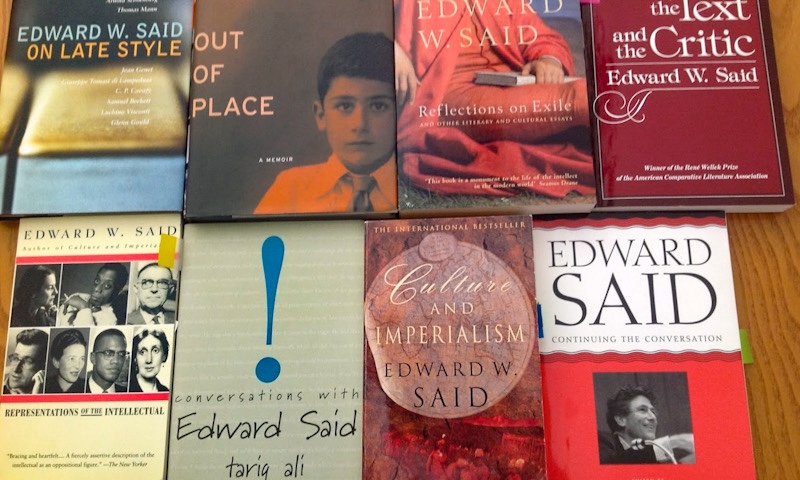
Edward Said
In 1971, the FBI opened a file on Said after an informant turned in a program from the Arab-American University Graduates conference, where Said held a panel on “Culture and the Critical Spirit.” The files reveal that FBI operatives read through his books and essays, perhaps looking for secret coded messages. When detailed summaries were submitted, Said was described as “a skilled writer whose works have been translated into eight languages.” In their briefings, they sounded more like curious students than secret agents. His intellect was that disarming.
Out of Place (1999)
In 1991, Said was diagnosed with leukemia and set to write a memoir of his childhood and pre-political life. His parents were Palestinians by birth – his mother was born in Nazareth, his father in Jerusalem. They were a Christian Arab family, and a Jewish midwife chanted blessings in Hebrew and Arabic when he was born.
By his twelfth birthday in 1947, the situation had become so contentious in Palestine that his family decided to move to Cairo, just five months before a civil war broke out following the Declaration of the State of Israel. So begins his life of exile.
He was among the first generation of 750,000 Palestinian refugees that would be scattered throughout the Arab world and beyond. He watched members of his extended family succumb to the uncertainty of their own existence. Without a country and lost in complex immigration laws, they were unable to work and unable to travel. Even less fortunate were those who ended up in camps until they died or, worse, massacred.
His aunt, who also fled to Cairo, worked on behalf of the refugees, helping them with paperwork, finding residence and employment, and referring them to doctors. Said was too young to understand the gravity of politics and history, but he could never forget the calamity and degradation on their faces. He was one of the few lucky ones. His family had a successful business. His father had lived in the U.S. and was naturalized, so all his children were citizens by birthright.
Years later, he listed “Jerusalem, Palestine” as his birthplace when renewing his passport. The administrator said, “There is no Palestine. Palestine doesn’t exist.” He replied, “Israel didn’t exist when I was born.” As a compromise, his passport would only say “Jerusalem.”
Orientalism (1978)
In 1972, Said took a year-long sabbatical in Beirut. He used the time to study Arabic philology and literature. Although his education was in Western studies, he began associating his thinking and writing with his native self.
In the aftermath of the Arab-Israeli War of 1973, he started his seminal research on the way Eastern cultures, Arabic and Islamic in particular, were portrayed in the West. His analysis was methodical – he reached out to other Arab intellectuals and studied a vast corpus of Western writings about the Middle East. In Orientalism, he exposed how Orientalists have perpetuated the idea of the Middle East as an inferior, violent place in order to defend European colonization and occupation. He addressed the grave misunderstanding and diminishing of other people only so the West could feel superior and explained the rich cultural diversity and intricate history of non-Western societies.
It was groundbreaking work – a thorough evaluation of the kind of single-sided history, media, politics and literature to avoid. Afterward, American universities incorporated Middle Eastern studies and post-colonial critical theory into their curriculums.
The Question of Palestine (1979)
“‘There was no such thing as Palestinians,’ said Golda Meir in 1969, and that set me the challenge of disproving her, of beginning to articulate a history of loss and dispossession.”
-Edward Said
And so begins Said’s lonely plight for the Palestinian cause and it would take a lifetime of intellectual courage to articulate it. In the 1960s, streets were rife with anti-war protests and the Civil Rights Movement. The question of Palestine was hardly on anyone’s mind, except for when the U.S. reiterated its stance as Israel’s ally in the Middle East.
Golda Meir’s statement was based on the case that Palestine was never an independent state. It was part of the Ottoman Empire and fell under British Mandate after WWI. On the surface, the British were tasked with preparing it for independence, but the mandate system, set up by Western powers, was nothing more than another form of occupation and colonialism.
As the Jewish population was facing prejudice, persecution and expulsion all over Europe, the British government issued the Balfour Declaration in 1917, pledging their support for the establishment of a Jewish homeland in Palestine while also promising Arab independence.
Backed by France and other allies, that was their solution to the growing “Jewish problem” – to resettle them off European lands. They also hoped a pro-British Jewish state in Palestine would help protect their interests in the Suez Canal – a vital passageway to their colonial possessions in India. It was nothing more than self-serving geopolitics.
The region of Palestine has been found in Egyptian texts as early as the 12th century BCE and from the Greek historian Herodotus in the 5th century BCE. By the 7th century, it was recognized throughout the Islamic world for its religious significance before falling to Ottoman rule, under which Jewish immigration was authorized for those facing discrimination in European countries. Palestine constituted 10% Jews, 10% Christians and 80% Muslims. Under the British Mandate, which helped sponsor and transport Jewish immigrants, the Jewish population grew to 30% by 1939, displacing tens of thousands of Palestinians. It empowered the Zionist movement, gave rise to Arab nationalism, and ignited a still-unresolved conflict that has spread throughout the Middle East.
But no matter the context and in contrast to Golda Meir’s words, the fact is Palestinians were on that land.
In The Question of Palestine, Said further explains how the ultimate partition of Palestine and support for Israel after WWII was the consequence of worldwide guilt over the Holocaust. Though it had nothing to do with Palestinians, they were left to suffer decades of displacement and were never granted the independence they were promised. Illegal occupation of Palestinian land continues to this day and they have been living under a system of apartheid that dictates where and when they can go.
The Question of Palestine is heartbreaking in its telling of everything that has happened to Palestinians in the past. But even more so in what is still happening to them now.