
Flowers and Hallucinations
Yayoi Kusama was born in 1929 in Matsumoto, a central city along the Japanese Alps. Her family owned the biggest nursery in the region, and plants and flowers surrounded her home. The visual and auditory hallucinations started when she was ten when a pumpkin she pulled off the vines began speaking, and she heard the souls of nature communicating. Another time, in a field of violets, she sensed the flowers growing all around her, covering the horizon and the sky.
Even indoors, she felt patterns on decorations and fabrics of curtains descending upon her. Dots of lights kept blinking in her mind. At first, she would flee to a room or cupboard and hide. When it continued to happen, she drew them, filling sketchbooks with flowers and visions. Recording helped erase the fear. Soon, she would harness all these “unseen reverberations” and use them as foundations for her art.
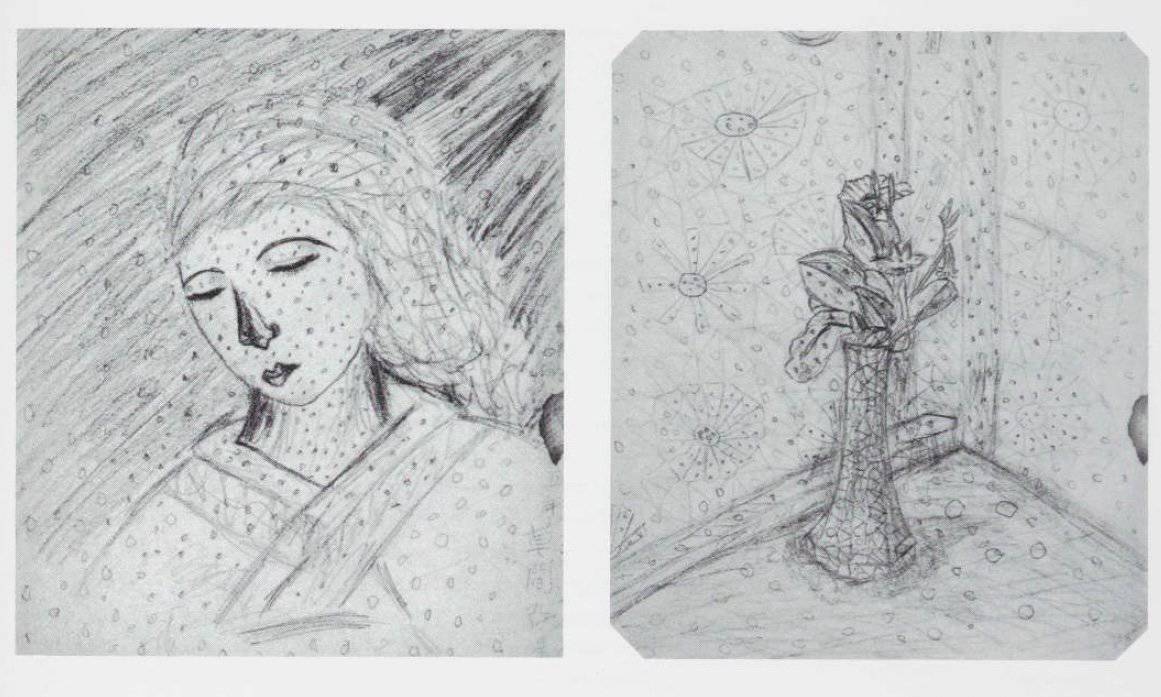
Early drawings c. 1939
“Images flowed from my mind the way lava flows from an erupting volcano.”
Her first submission to an exhibition – a painting of pumpkins of various sizes – won a prize. In 1948, she moved to Kyoto to study and began her days meditating at dawn before painting well into the night. The psychiatrist who had been treating her, Dr. Shiho Nishimaru, came to her second exhibition and encouraged her to pursue art. He would write and lecture on Genius Woman Artist With Schizophrenic Tendency, a scientific paper based on Kusama.
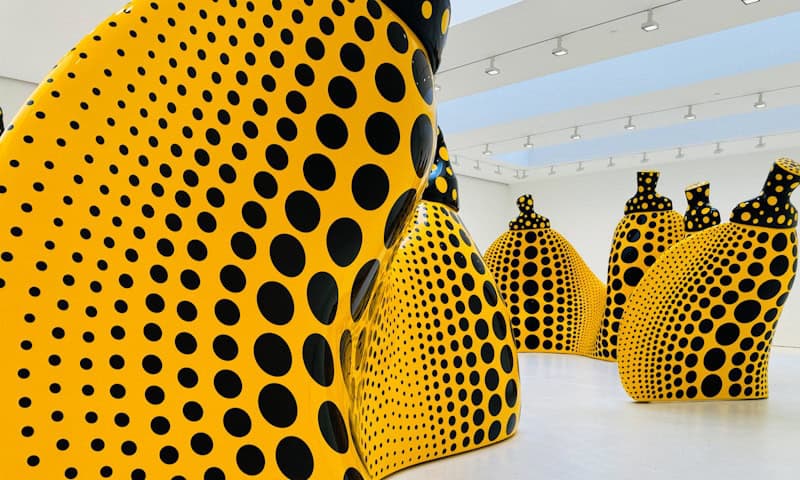
Aspiring to Pumpkins Love (2023)
Infinity Nets
Inspired by Georgia O’Keefe, Kusama headed to New York in 1957. Before leaving, she destroyed thousands of paintings, vowing to paint even better ones. The art scene was dominated by de Kooning, Rothko, Lichtenstein, and Warhol. She faced avid sexism and, as a Japanese, prejudice in post-WWII America. Undeterred, she painted night and day on canvases so large she needed a stepladder to complete them. Whenever she suffered severe hallucinations, she would rush to Bellevue, then return home and paint just as madly. With help from O’Keefe, she sold some of her paintings.
In 1959, the Breta Gallery hosted her first solo exhibition in the U.S. Obsessional Monochrome displayed the white-on-black infinity net paintings she had been working on. The canvases were painted to the edges with small enclosing semicircles that, upon closer inspection, appear like delicate lace. The repetitive patterns of painted arches are bewildering and hypnotic.

Infinity Nets
“I issued a manifesto stating that everything – myself, others, the entire universe – would be obliterated by white nets of nothingness connecting astronomical accumulations of dots.”
The show received immediate acclaim. Numerous solo and group exhibitions followed. Art News critic Donald Judd was the first to buy one of the paintings and would become a lifelong friend and collaborator.
Soft Sculptures
In 1961, she began creating her soft sculptures – stuffed textile phallic pieces she used to cover objects. As a child, she was made to spy on her father’s mistresses and report to her mother. The experience traumatized and enraged her. She despised and pitied her mother, who, in turn, was spiteful and helpless.
Because she was terrified of sex, making the phalluses became self-therapy. She termed it “psychosomatic art” and used it as a way of exorcising her sexual sickness. During WWII, she had to work in a factory that made parachutes. She was adept at sewing and created tens of thousands of phallic sculptures.
“That turns the frightening thing into something funny, something amusing.”
She first exhibited them at a group exhibition in 1962, contributing an armchair and sofa completely covered with stuffed phalluses. She had her first solo installation at the Gertrude Stein Gallery the following year. Aggregation: One Thousand Boats Show featured a rowboat covered with countless white phalluses. Surrounding it on the walls and ceilings were 999 poster-sized photos of the sculpture. It was dizzying and captivating.
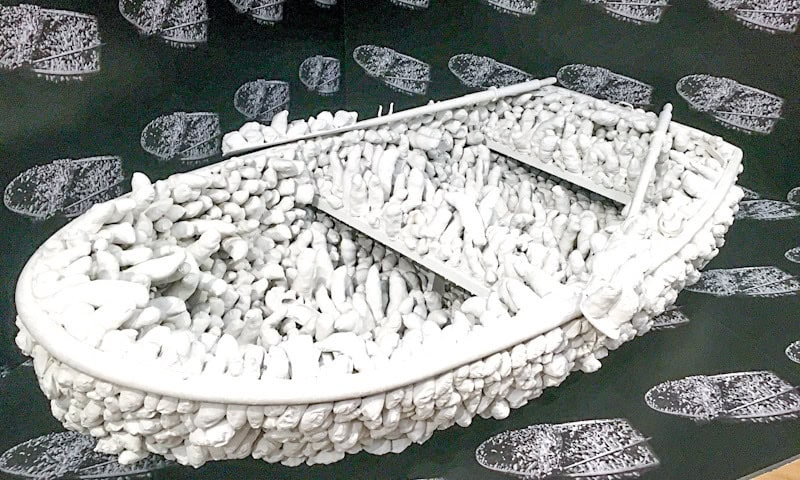
Aggregation: One Thousand Boats Show (1963)
Claes Oldenburg’s soft sculptures and Warhol’s silkscreen posters were directly taken from Kusama’s art. Though she received little recognition for her innovations, they helped launch her male contemporaries. She covered her studio windows and worked in secret.
Mirror Rooms
She reemerged in 1965 at the Castellane Gallery. Her exploration of three-dimensional and spatial art culminated in the first of her infinity rooms. On the floor of Phalli’s Field were thousands of polka-dot sculptures in an all-mirrored room. Upon entering, the room played on infinite perspective and was among the first artworks in which the viewer became part of the installation. It’s imaginative and whimsical.

Phalli’s Field (1965)
The same gallery held another installation the following year. Endless Love Show was a single multi-media installation. A hexagon room covered with mirrors – the walls, floor and ceiling – and embedded with small multi-colored light bulbs programmed to blink to music. It’s a psychedelic kaleidoscope – Kusama’s way of trying to convey some of the hallucinations in her head.

Endless Love Show/Love Forever (1966/1994)
“This was my living, breathing manifesto of Love. Thousands of illuminated colors are blinking at the speed of light.”
Again, another artist, Lucas Samaras, took the idea and debuted Corridor #2, a mirror room reflecting green and white light. His show sold out, and Kusama sank deeper into anxiety and depression. She attempted suicide by jumping out of her studio window. Fortunately, a bicycle on the sidewalk broke her fall.
Kusama Happenings
In 1967, Kusama turned to performance art. Inspired by the burgeoning hippie culture and anti-war movement, she produced the Body Paint Festival. Staged in front of Saint Patrick’s Cathedral, she instructed her models to remove their clothing and burn American flags. She threw draft cards and bibles into the flames. Afterward, her models embraced and kissed; some even started to have sex.
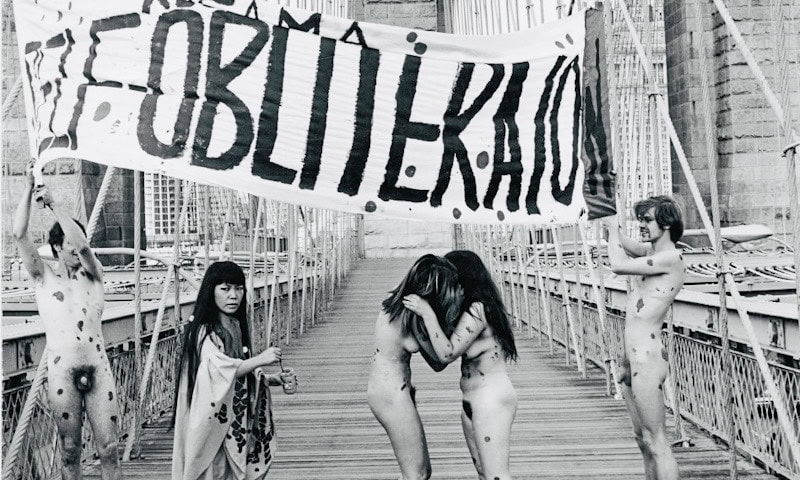
Anti-War Naked Happening and Flag Burning (1968)
The ensuing coverage and outrage elevated her to the limelight. The next Happening used the Endless Love Room in her studio, but this time with a living sculpture on the floor – a group having sex. They whipped each other with leather belts and then painted polka-dots on their bodies. A crew from Germany filmed and broadcasted the event. Her Happenings – part protests, part sex parties – gained fans and even more notoriety. She was always the producer, creator and choreographer, never a participant. If a boy got out of line, she whipped him herself.
She was invited to Europe to produce Happenings in Amsterdam, Delft, Belgium, and Germany. Each would result in a struggle between spectators urging them on and police ordering them to stop. Back in New York, she formed the Church of Self-Obliteration and began to officiate in Homosexual Weddings – part performances, part matrimonial ceremonies. Her entourage would grow to include a Kusama Dancing Team and over 200 performers she could call on for her events.

Studio Happenings
Body Paint Enterprises
In 1968 and 1969, Kusama launched a series of projects to channel her creative energy. The first was the full-service production of her Happenings, which included Kusama Enterprises, Kusama Musical Productions and Kusama Polka-Dot Church. Kusama International Film Productions sold recordings of the Happenings, and Flower Orgy and Homosexual Orgy were screened in museums around the world. The Kusama Sex Company hosted sex parties and sold spread shots and posters. Kusama felt it was important to empower women with a sexual revolution.
“The wife whose husband has left her weeping should herself participate in an orgy or attend partner-swapping parties.”
To demonstrate the art of naked body painting, she went on The Tonight Show and staged a musical. In her studio, the Happenings became participatory, where the audience was encouraged to strip naked and paint each other. She turned her Paint Studio into a modeling agency and founded a homosexual social club, Kusama’ Omophile Kompany (the acronym KOK was a homophone). She ventured into publishing with Kusama Orgy, a weekly newspaper subtitled “Nudity, Love, Sex and Beauty.” It was sold at newsstands across the country.
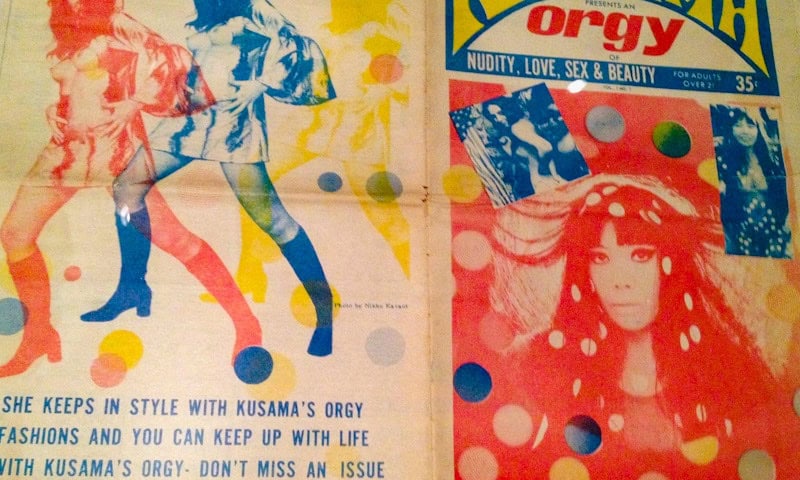
Kusma Orgy Magazine
She expanded into clothing and accessories with Kusama Fashion Company and Nude Fashion. Her dresses included her See-Through, Way-Out and Homo Dress designs and were sold in over 400 stores, including Bloomingdales, which set up Kusama’s Corner displays.
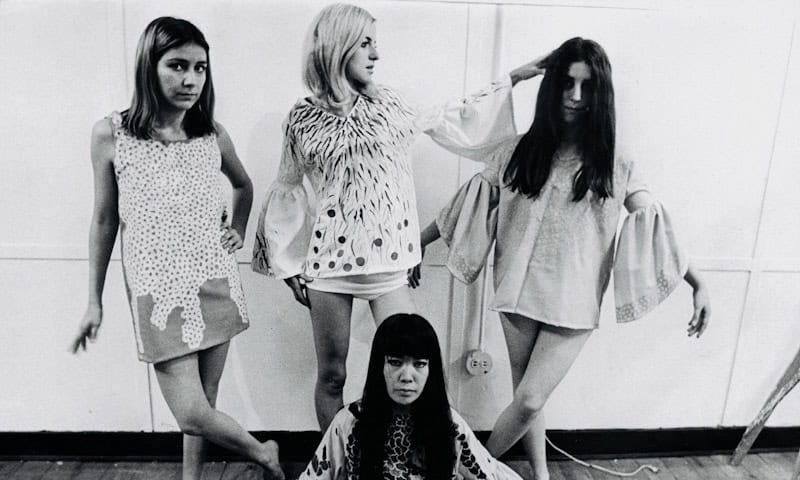
Kusama Fashion
A Platonic Love
In 1962, an art dealer introduced her to Joseph Cornell, an eccentric and reclusive artist 26 years her senior. Collectors clamored for his art, but he often refused to sell them. He was more receptive to attractive women, and the dealer was a good friend, so Kusama wore her best kimono and agreed to come along.
Cornell was affiliated with the Surrealists and created shadow boxes using collage and assemblage techniques. He collected seashells, bits of metal, wooden boxes and stacks of magazines and used the simplest tools – scissors, pliers, nails and a hammer. He had the ability to turn the most ordinary objects into something magical.
He and Kusama had exhibited in a group show just the month before but had yet to meet. The art dealer was rewarded with one of his delicate boxes for the introduction. Soon after, Kusama began receiving poems he’d written for her. Her mailbox would overflow, sometimes with over a dozen letters at a time.
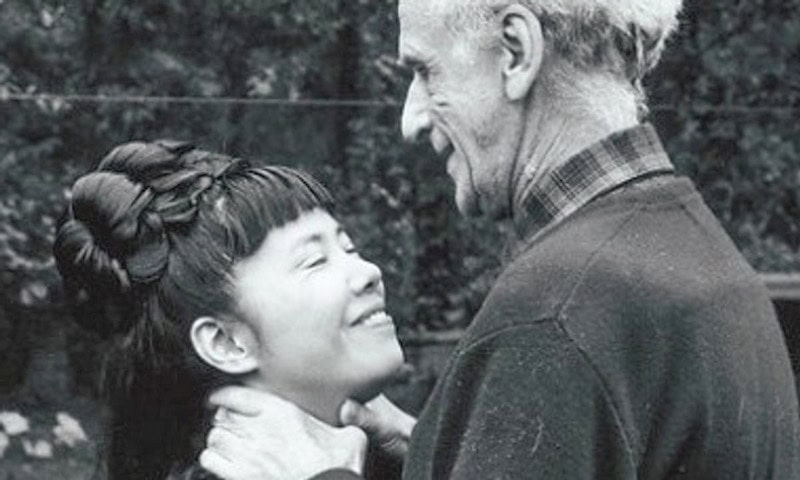
Kusama and Cornell (1970)
He chose a noble, solitary life that enamored and exasperated her. Although she enjoyed talking to him, he would insist on waiting on the phone even for hours while she ran errands or went out for dinner. He would always be on the line, still holding when she returned. Cornell died in 1972. In the ten years they were lovers, they never once had sex. Instead, they spent many nights naked and sketched each other for hours.
“I love entering Joseph’s world. I thought it was a wonderful, extraordinary place. Just looking at one of his works could make me tremble.”
Returning to Japan
While Kusama had made a name for herself, she had yet to garner the same esteem and recognition as her male counterparts. The criticism over her Free Love art and stance was often only brutal and scandalous. She decided to return to Tokyo in 1973, only to find that Japan was even more sexually repressive.
Her art was virtually unknown in her home country. Any coverage she’d gotten in the past was over her sex clubs and Happenings, and it only ostracized her, especially from her conservative family. When her father died the following year, her mental health worsened. In 1977, she checked herself into Seiwa Hospital, an institute for the mentally ill. It runs a program that focuses on art therapy, and she’s lived there ever since with her studio set up down the street.

I Who Committed Suicide (1977)
She took up a quieter existence for the next decade, exploring other mediums, including collage, lithographs and printmaking, participating in local exhibitions, and writing stories and poetry. As with her painting, words poured from her torrent mind. If her art was an attempt to portray her madness, her poetry was a way to describe it.
In 1983, her novella The Hustlers Grotto of Christopher Street won the Yasei Jidei New Writers Award, and she focused on publishing in Japanese afterward.
“By writing novels and poems in Japanese, l was able to shine light on a different facet of myself. This allowed me to cultivate new spheres of self and reorient my soul.”
The Kumasa Renaissance
In the early 1980s, the criticism and scandals over her Happenings were fading. By then, naked paintings and sex parties were commonplace around the world. But it also meant her international stature had all but disappeared.
This changed when Japanese television, including NHK, FujiTV and TV Tokyo, began to cover her work and exhibitions. A curator from New York flew to visit Kusama and brought back a collection of her work. In 1989, the Center for International Contemporary Art (CICA) opened with Yayoi Kusama: A Retrospective. The catalog was a complete study of her life and art – including photographs, news articles, correspondence with the likes of O’Keefe, and the thousands of love letters from Cornell. Art in America ran a cover story on Kusama, the first for a Japanese artist.
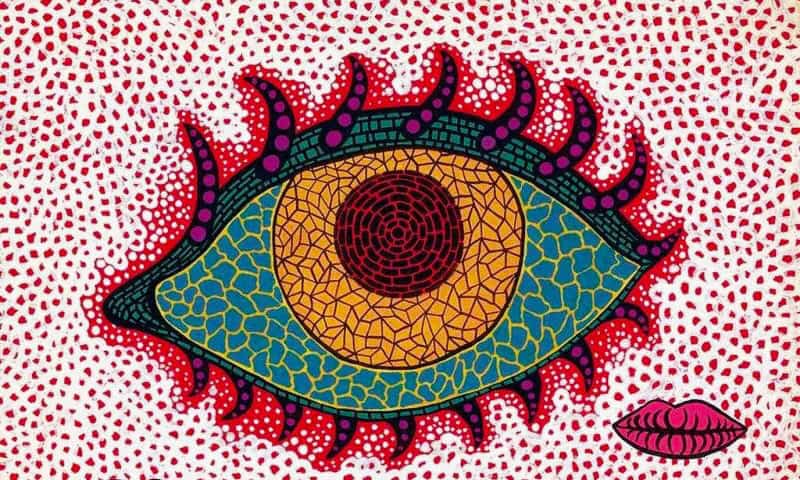
Hitomi (1989)
The Venice Biennale
Back in 1966, Kusama went to the Venice Biennale. Although she didn’t have a formal invitation, she was given a space for an installation. Narcissus Garden featured 1,500 mirrored balls in front of the Italian Pavilion. Her sign read “Your Narcissism for Sale – One Piece $2.” In an art world where pieces cost thousands and were reserved for the wealthy, it was radical and subversive. The officials made her stop selling.

Narcissus Garden (1966)
Twenty-seven years later, in 1993, she received an official invitation to the 45th Venice Biennale. She became the first woman to represent Japan, and it was the first time the Japanese Pavilion featured a single artist – in the past, two or several artists had shared it at a time. She exhibited twenty works, including a Mirror Room of her iconic pumpkins. This time, the international art world welcomed her with wide-open arms.

Mirror Room Pumpkin
Art for Eternity
Kusama’s star continued to rise. Soon, she collaborated with BMW, Louis Vuitton and Veuve Clicquot on limited-edition designs. In 2001, she partnered with Coca-Cola for an exhibition project. In 2002, she teamed up with Graf for a line of modernist furniture featuring her textile designs.
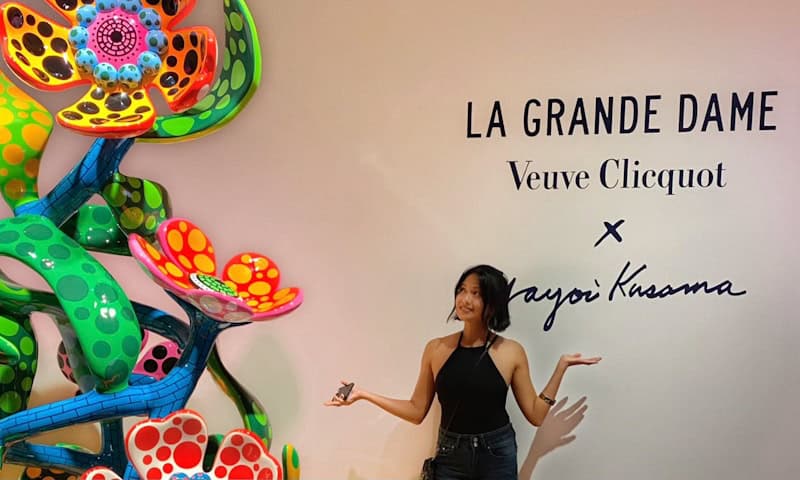
Veuve Clicquot x Yayoi Kusama
In 2009, she began painting for an upcoming retrospective at Tate. My Eternal Soul – originally conceived as a series of 100 paintings – has grown to over 500 and counting. This theme of infinite repetition is constant in her work, even mirrored in the number of paintings she executes.

My Eternal Soul Series
Her Infinity Mirror Rooms, which date back to the 1960s, have propelled her to the “most famous artist in the world.” In 2014, The Art Newspaper reported an astounding two million visitors to her retrospective Obsesión Infinita, which toured Central and South America. In Mexico City, attendees camped overnight, and the museum had to stay open for 36 hours to accommodate them for the last two days of the exhibition. In 2017, the Hirshhorn Museum doubled its attendance to 1.2 million when it exhibited One With Eternity: Yayoi Kusama. In January 2018, 75,000 people came to Infinity Mirrored Room: Let’s Survive Forever at David Zwirner Gallery in New York, many of them waiting for hours in frigid temperatures. This is despite time limits set to as little as 30-40 seconds and up to two minutes for large group.
That she’s made art made for social media long before there was social media is a testament to her genius. She has such a wide reach – from children to erudite art collectors. And they all continue to line up for a glimpse of the lights and patterns that once existed only in her mind. Me included.
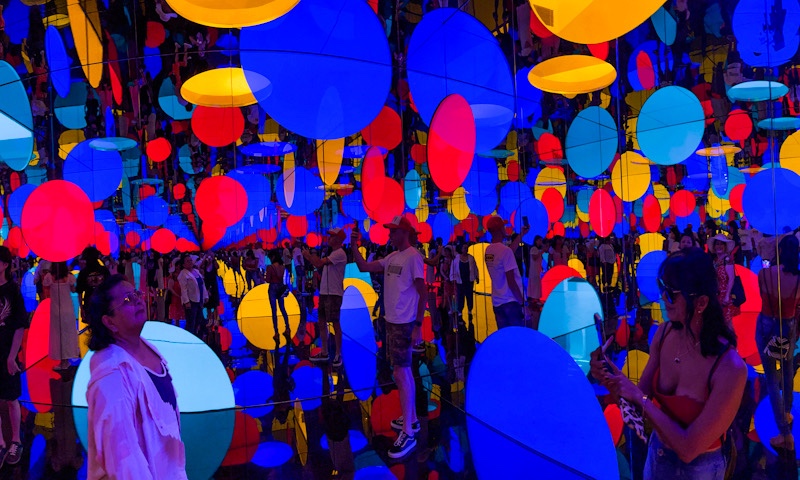
I Would Offer My Love (2023)
“I think I will be able to, in the end, rise above the clouds and climb the stairs to Heaven, and I will look down on my beautiful life.”