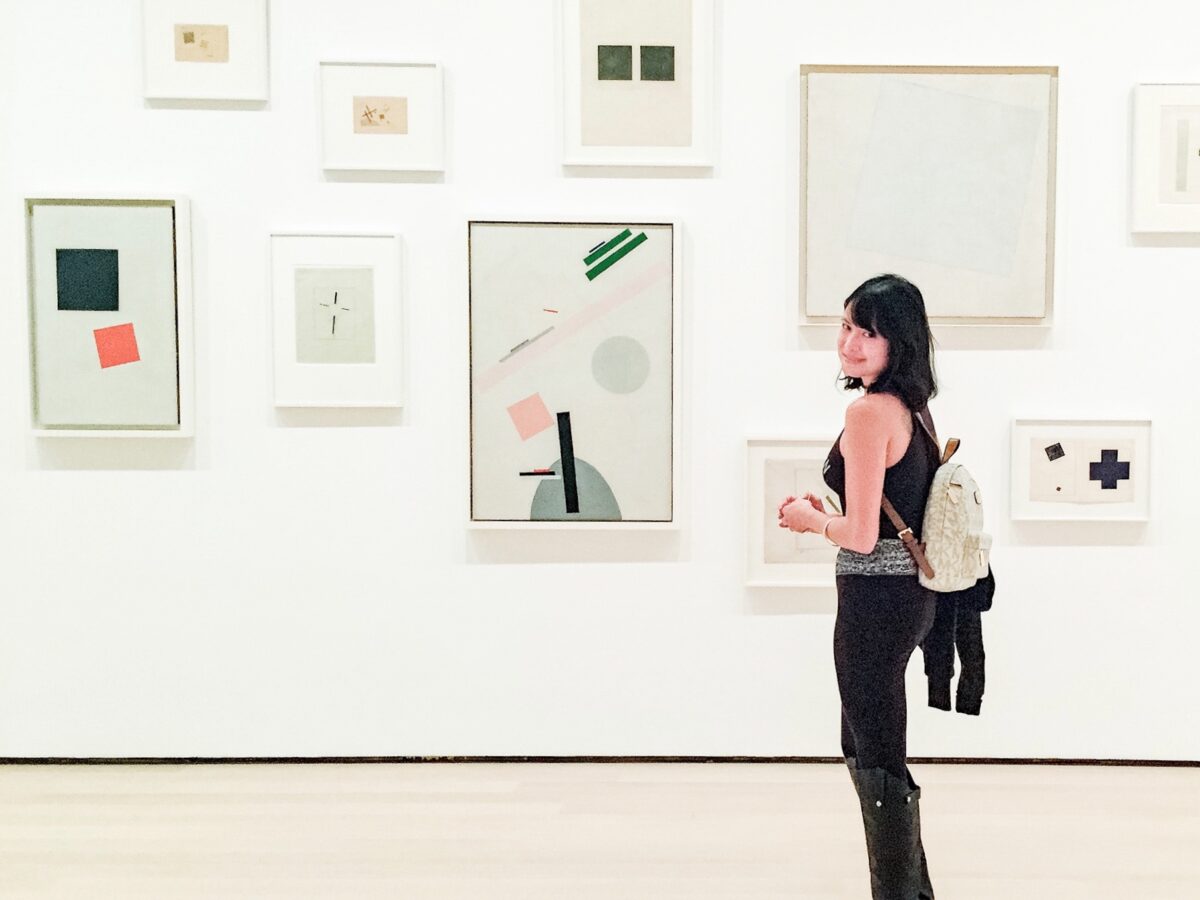
Driven by revolutionary fervor, the Russian avant-garde produced some of the most radical and influential in early 20th-century art and literature. Among them was Kazimir Malevich’s Suprematism. In 1915, he unveiled a series of thirty-nine completely nonrepresentational paintings along with a manifesto calling for a new abstraction – a refuge for pure emotion in painting, an art form that would lead to the “supremacy of feeling and perception.”
Realism vs. Symbolism
Two styles dominated Russian painting at the turn of the century. Realism was sparked by the Revolutions of 1848, which began in Sicily and reached over 50 countries, the most widespread in history. It was a mass organization of the working class who called for economic reforms and wanted an end to autocratic rule. Most of them were quickly suppressed, with few consequential changes, such as the abolition of feudalism in Germany and Austria and the end of absolute monarchy in Denmark. Several governments would eventually restructure their public sectors to function more effectively, including the Netherlands, where constitutional reforms resulted in a representative democracy.
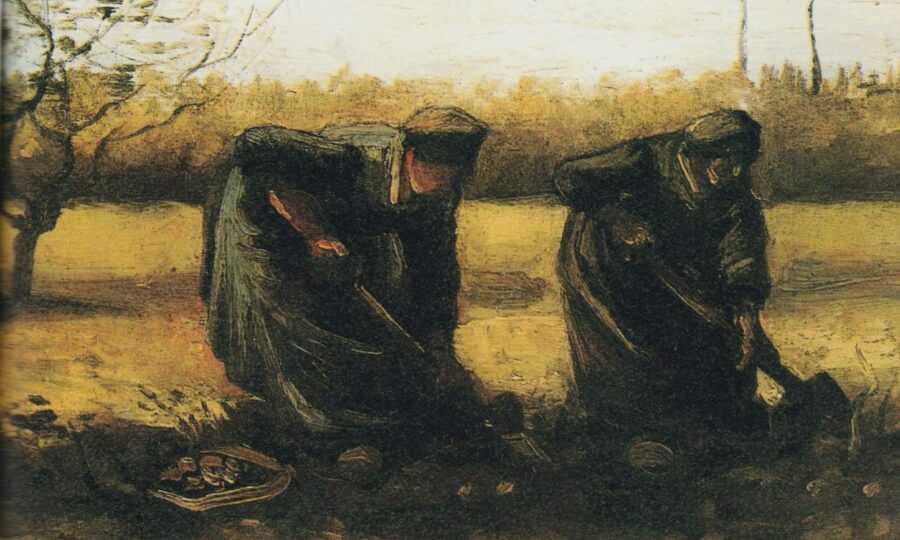
Van Gogh, Two Women Digging Potatoes (1885)

Malevich, Peasant Women at Church (1911)
Although the revolutions were short-lived, they gave way to a new style in art and literature. Realism sought to emphasize the lives of ordinary people and expose the exploitation of the working class. It broke away from Romanticism and mythological themes, favoring contemporary subjects and social issues. Even more lasting is the effect of the 1848 publication of Karl Marx’s The Communist Manifesto, which would become the most influential pamphlet in political history.
Symbolism emerged as a reaction to realism. It favored the spiritual and the imaginary over materialism and objects. Symbolist writers and artists sought to convey ideas and emotions through metaphorical, allegorical and “symbolic” imagery. It first emerged in France with the poetry of Charles Baudelaire and Paul Verlaine and soon influenced Russian artists, including Mikhail Vrubel and Malevich, who drew on the country’s rich tradition of philosophy and folklore.
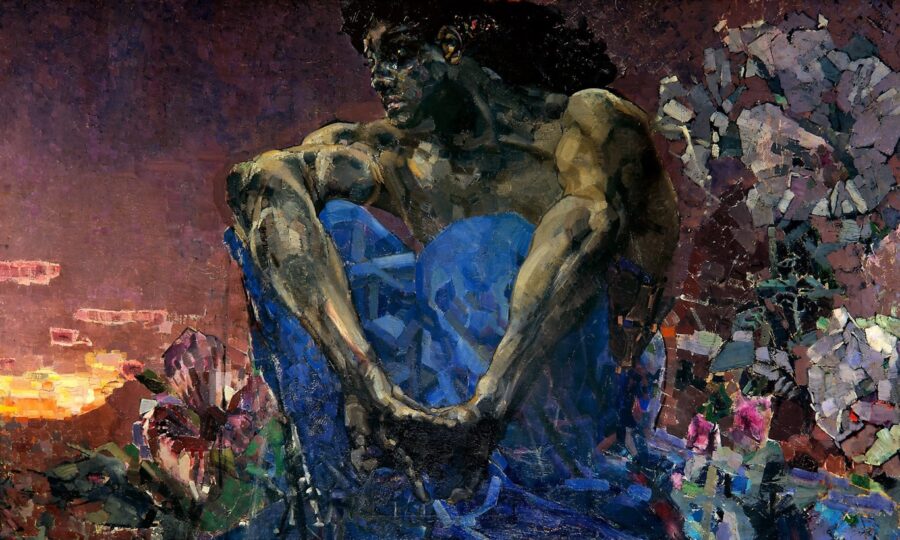
Vrubel, The Demon Seated (1890)
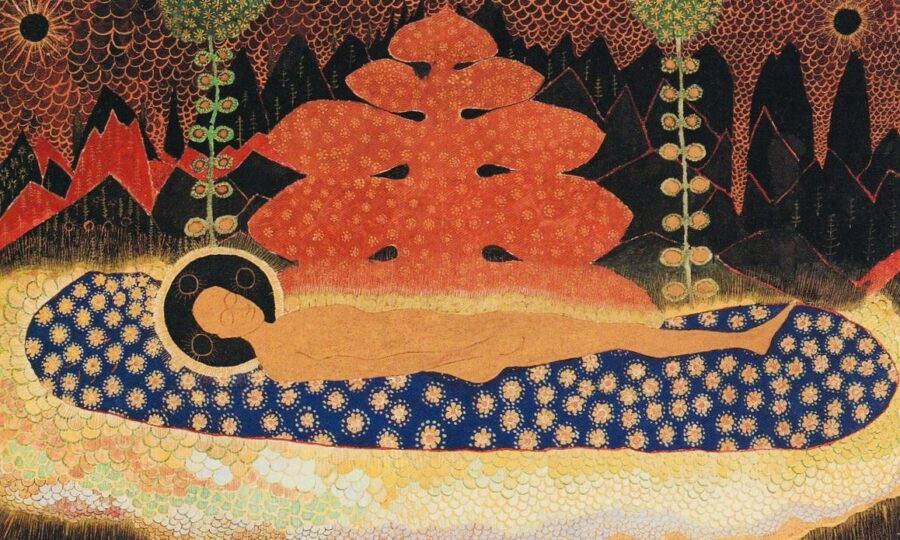
Malevich, Shroud of Christ (1908)
Fast-forward to the 1905 Russian Revolution. While it also failed to overthrow the czarist regime, it sparked a period of social and political upheaval. Writers and painters saw their art as a revolutionary tool, a way to challenge the status quo and spread new ideas.
From Impressionism to Cubism
Originally from Kiev, where he studied drawing, Malevich settled in Moscow the year after the 1905 Revolution. The city was a breeding ground for like-minded individuals, and he wanted to steep himself in the most current styles of painting. Several private art collections were available for viewing, and he visited them often. Sergei Shchukin, who belonged to a family of wealthy businessmen and collectors, bought his first Monet on a trip to Paris in 1897 and amassed a total of 258 paintings decorating his palatial walls. It was Malevich’s first exposure to the French Impressionists, including Renoir, Matisse and Cézanne. Textile magnate brothers Ivan and Mikhail Morozov also had growing collections, including Manet, Seurat, and Gaugin.
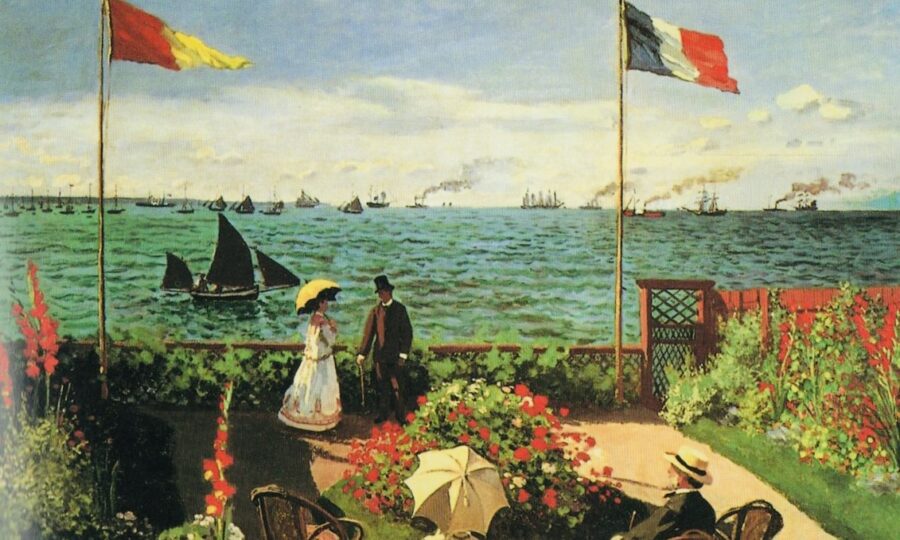
Monet, Garden at Sainte Adresse (1867)

Malevich, On the Boulevard (1903)
Cézanne’s experimentation with perspective and geometric forms influenced Malevich the most. In his later works, Cézanne broke away from linear perspective and often depicted his subject and landscape as if they could be seen from different angles. His use of multiple planes in a single view is credited as the bridge between Impressionism and Cubism.
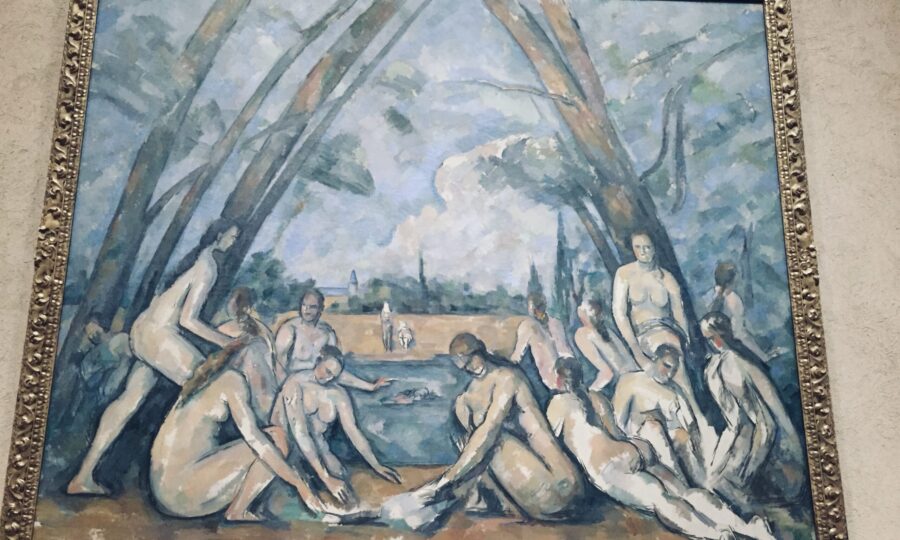
Cézanne, The Bathers (1898)
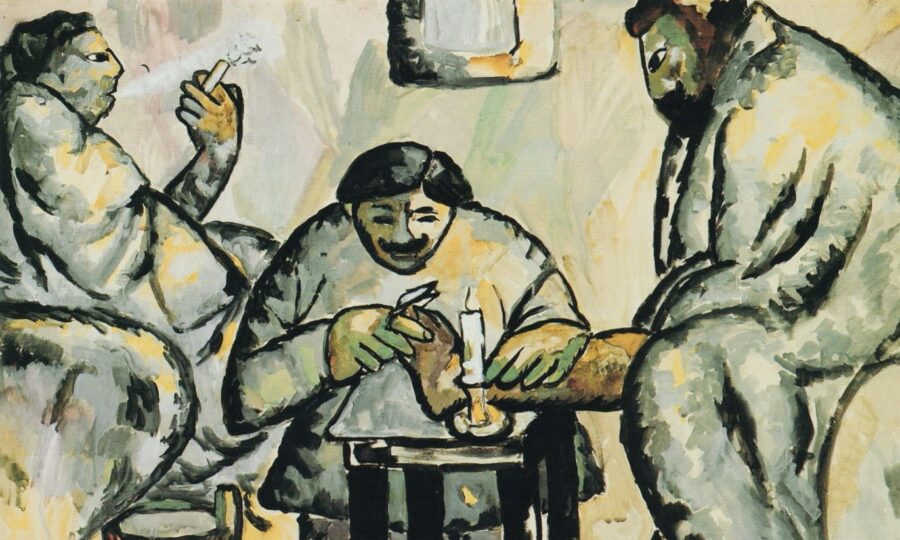
Malevich, At the Bathhouse (1912)
Beginning in 1907, Malevich took part in several exhibitions alongside leading contemporary Russian artists, including Vasily Kandinsky, Marc Chagall and Vladimir Tatlin. In 1908, at an international exhibition, he discovered Georges Braque, the first Cubist painter shown in Russia.
The Russian Futurists
In 1912, the Moscow-based literary group Hylaea issued a manifesto advocating the artistic philosophy of Italian poet Filippo Tommaso Marinetti, whose 1908 Manifesto of Futurism called for the rejection of the past and the embracing of machinery and industry to achieve better living standards. Writers and artists believed they could contribute to these ideals by modernizing art and culture. Malevich joined immediately and, in homage to Braque, used the term Cubo-Futurism to refer to his style of painting. Other prominent members of the Russian Futurists included the poet Vladimir Mayakovski and female painter Lyubov Popova.

Braque, Musical Instruments (1908)
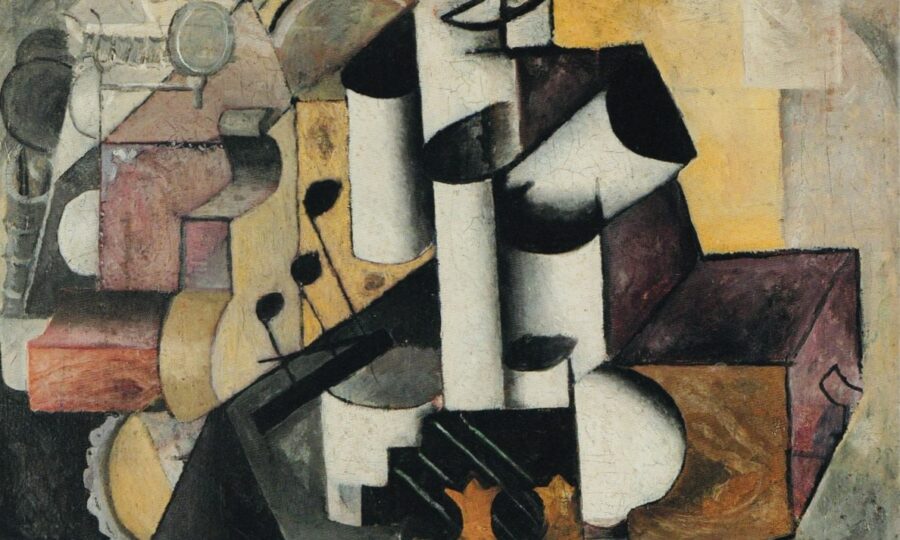
Malevich, Musical Instrument/Lamp (1913)
Futurism spread to music, cinema and theater. In 1913, Malevich joined the production of Victory Over the Sun, a Futurist opera with a libretto in a new experimental language. The writers Velimir Khlebnikov and Aleksei Kruchenykh were contributing members of the Hylaea manifesto, and they called the language Zaum. It explored the use of speech that goes beyond meaning, recovering the origin and symbol of words through sounds. Malevich always had a keen interest in the rules of language, and he was fascinated.
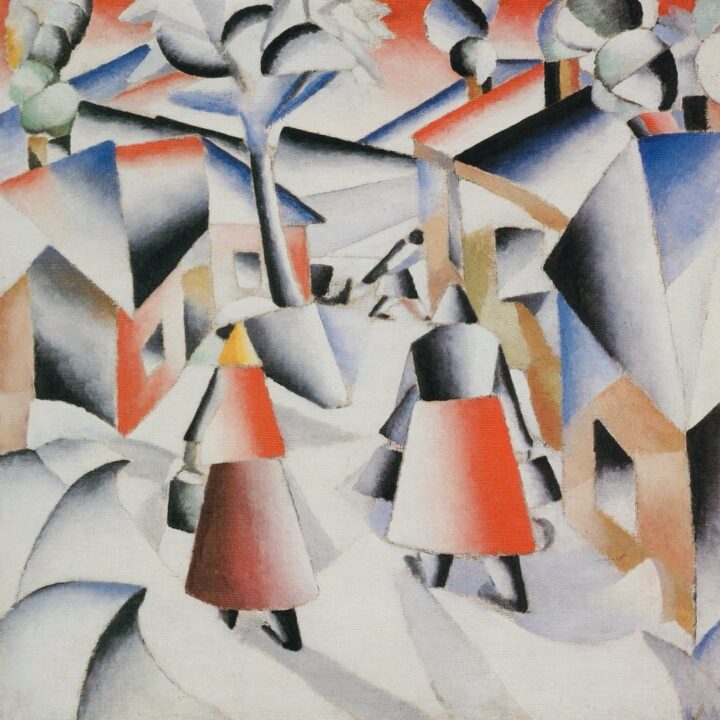
Malevich, Morning in the Country after Snowstorm (1912)

Malevich, The Knife Grinder (1913)
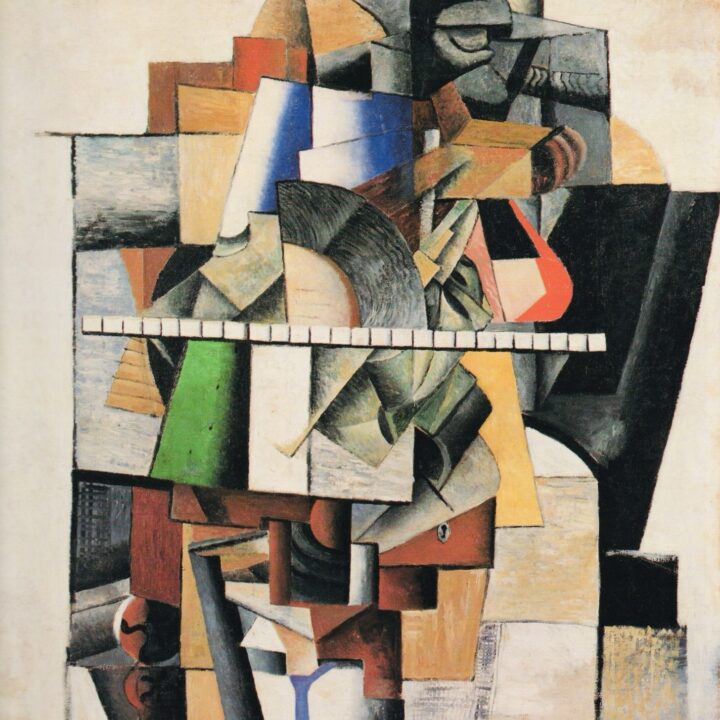
Malevich, Portrait of Mikhail Matiushin (1913)
The opera infused traditional Russian folklore with anarchic ideals. It took on a very abstract production. The music was by Mikhail Matiushin, a composer and painter who studied physiology and developed a concept connecting musical and visual arts. Malevich designed the costumes and stage but, due to a lack of funds, could not paint in color. The result was a monochromatic setting with a backdrop of a black square.
Suprematism and Constructivism
The opera was not well received critically, and the Futurist style was not universally accepted overall, especially since the Italian group was aligned with Fascism. The Russian Futurists sought new ideologies, ways of thinking and expression. At this point, Malevich has painted in the most prominent styles he’s been exposed to. While working on propaganda posters during the outbreak of WWI, he continued to explore geometric forms and non-objective painting.
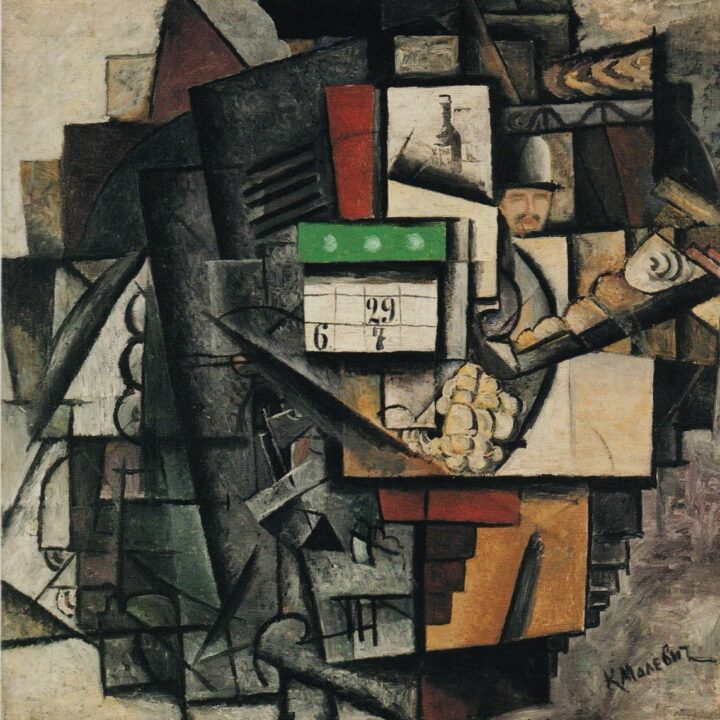
Malevich, Lady in a Tram (1913)
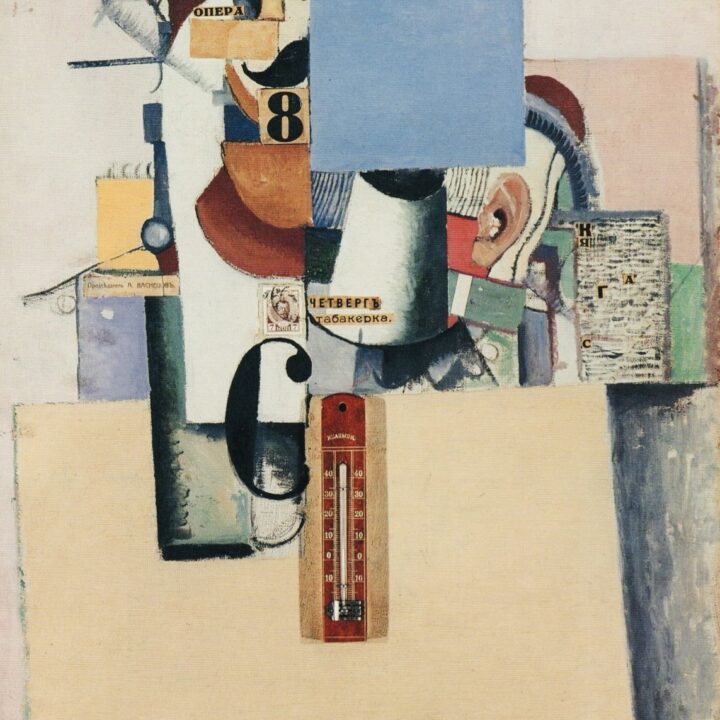
Malevich, Warrior of the First Division (1914)

Malevich, Guardsman (1914)
In December 1915, at the Last Futurist Exhibition 0.10 (Zero-Ten) in Petrograd (now St. Petersburg), he took the definitive step towards pure abstraction, the tabula rasa or “ground zero” from which the history of painting could be rewritten. The “ten” was the number of artists who participated. Malevich wrote an essay, From Cubism to Suprematism, to accompany the series of work he showcased.
The artist can be a creator only when the forms in his pictures have nothing in common with nature. To the Suprematist, the visual phenomena of the objective world are, in themselves, meaningless; the significant thing is feeling.
This new art was to represent a philosophical way of thinking, not material objects. The paintings were rudimentary in shapes and colors. The most radical was The Black Square. It was hung on the top corner – a space usually reserved for religious icons – to signify Malevich’s beliefs in the transformative power of art and Suprematism as a philosophical movement. It broke free from both conventional painting and cultural tradition. Although painted in 1915, he dated it to 1913, the year it was conceived as the backdrop for Victory Over the Sun.
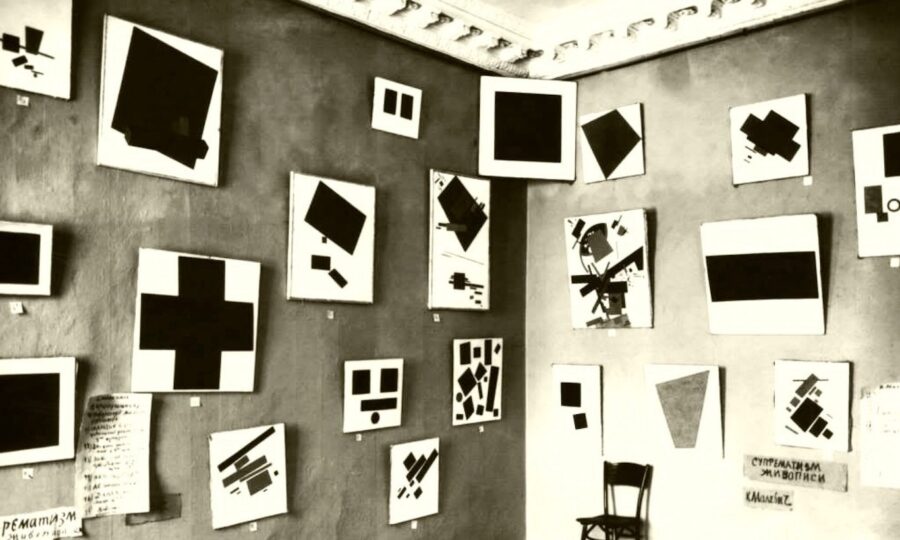
Malevich Room, 0.10 Exhibition (1915)

Tatlin, Corner Counter-Relief (1915)
Displayed in the next room were sculptures by Tatlin. The three-dimensional “counter-reliefs” questioned traditional ideas of art and sculpture. Their rugged construction of wood and metal was representative of the working class and marked the birth of Constructivism, a style that would also be adopted in architecture. With these, Malevich and Tatlin became the two most influential figures in the Russian avant-garde.
Soon, Malevich was giving lectures and demonstrations on Suprematist art. Throughout 1916, subsequent exhibitions of his paintings were held. Matiushin, Popova, Ivan Kliun and several other avant-garde artists joined to form the group Supremus and worked on publications for their theories on art. From The Black Square, Malevich derived a variety of circles and rectangles using a number of colors. He felt he was inventing a pictorial language for a new world.

Malevich, Eight Red Rectangles (1915)

Malevich, Nonobjective Painting (1915)

Malevich, Suprematism (1915)
The Russian Revolution
That new world came soon enough as the rise of the Russian avant-garde coincided with the 1917 Revolution. In February, after the Red Army suffered catastrophic losses in WWI, civil unrest once again erupted across the country. Hoping to quell them, Czar Nicholas II stepped down. But by October, the provisional government lost all control to soviet councils (workers unions) and the Bolsheviks.
The new regime gave official sanction to avant-garde art, which had embraced the revolutionary spirit from the beginning and whose philosophical aesthetics seemed to fit Marxist ideals. Malevich, Tatlin and Mayakovsky were among those who worked on government commissions and proletariat propaganda. They helped establish museums, committees and educational programs to form a modern Soviet society. Malevich was appointed Commissar and headed art departments in the newly-opened Free State Art Studios (SMOVAS). He taught Suprematist art while continuing to exhibit.
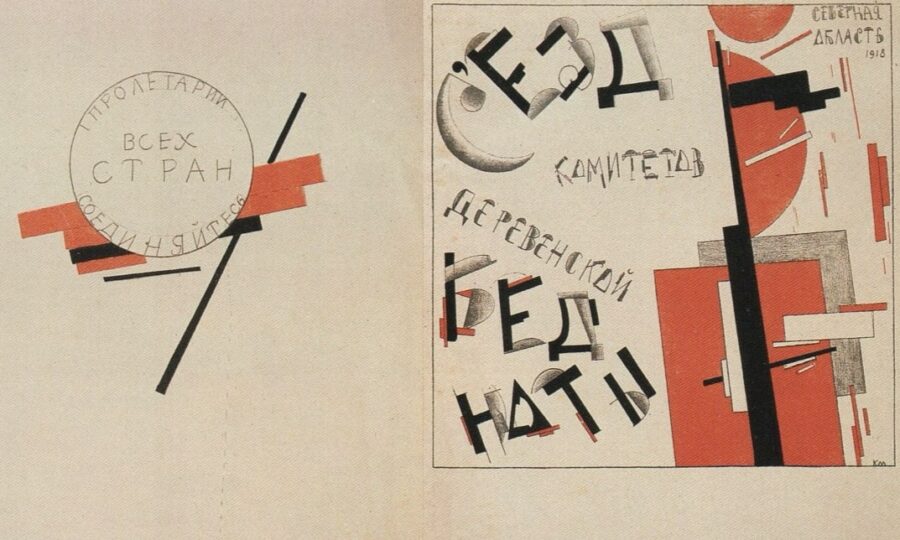
Malevich, Program to address poverty (1918)
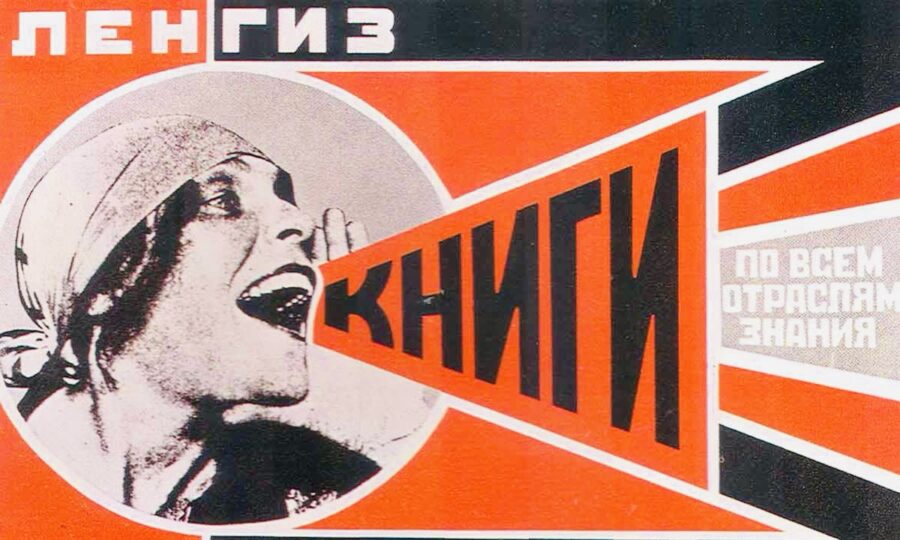
Rodchenko, Books Please (1924)
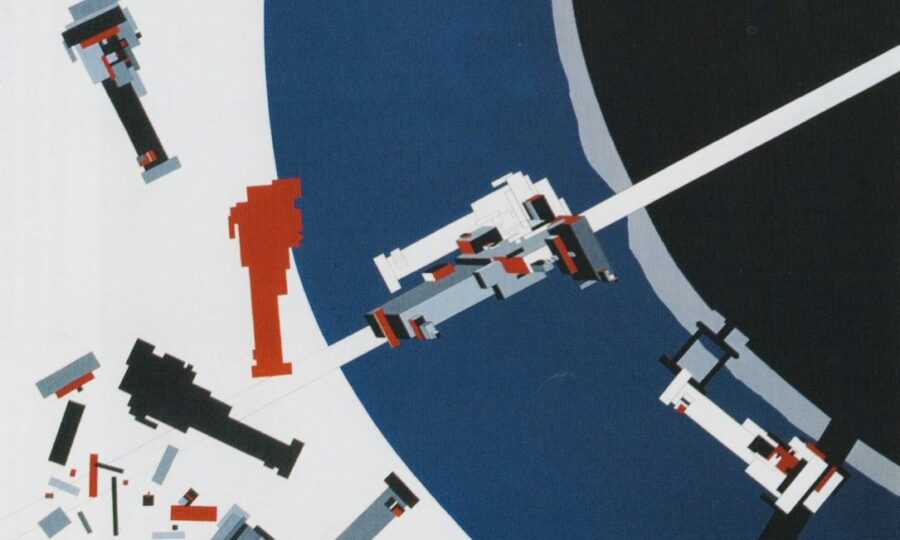
Architektons
In 1919, he was invited to teach at the Popular Art Institute in Vitebsk (now part of Belarus). He introduced a new educational program in which all art forms are integrated into a universal system – UNOVIS. As a collective in line with Communist ideals, the group shared responsibility and credit, signing all their works with a solitary black square.
During this time, Malevich explored ways to apply Suprematism to other art forms and for objects of practical use. UNOVIS designed advertisements, monuments, theater stages and furniture. Malevich began constructing architectural models – a three-dimensional development for building and urban planning. These Architektons were composed of pure geometric forms designed to integrate art into everyday life. He also shifted his focus from painting to theoretical research and publishing.

Malevich, Beta (c 1926)

Malevich, Textile design (1919)
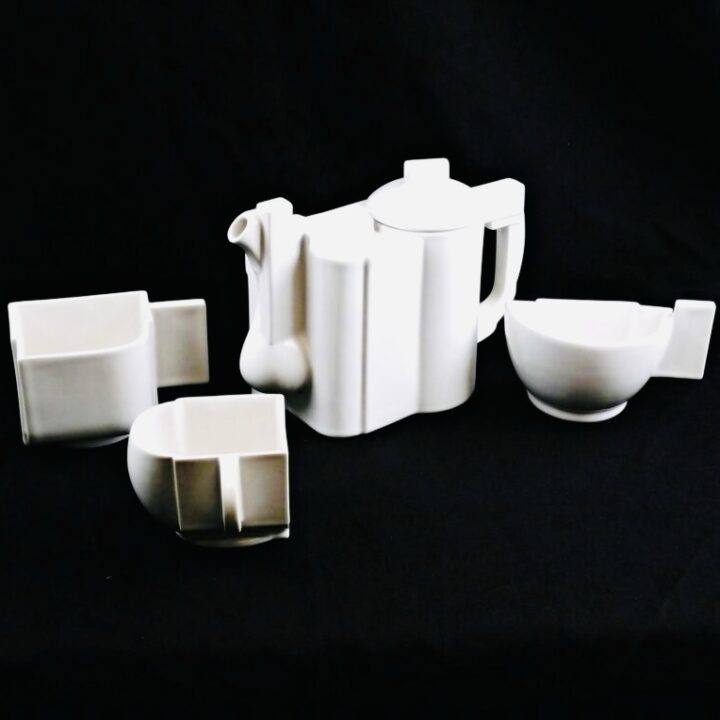
Malevich, Tea set (1923)
In 1920, two publications, a UNOVIS almanac and Malevich’s On New Systems in Art, both highlighting the use of Suprematism in everyday life, were distributed. Additional UNOVIS collectives were established in other cities. The Suprematist style was adopted on a grand scale, finding its way into factories for the production of porcelain and textiles.
The Bauhaus
In 1927, Malevich traveled for the first and only time out west to exhibit in Poland and Germany. He brought a substantial body of work – at least 70 pieces – from his Post-Impressionist days to his Architektons. He also gave lectures, accompanied by his own publications and theoretical charts.

Malevich, Apple Trees in Blossom (1904)
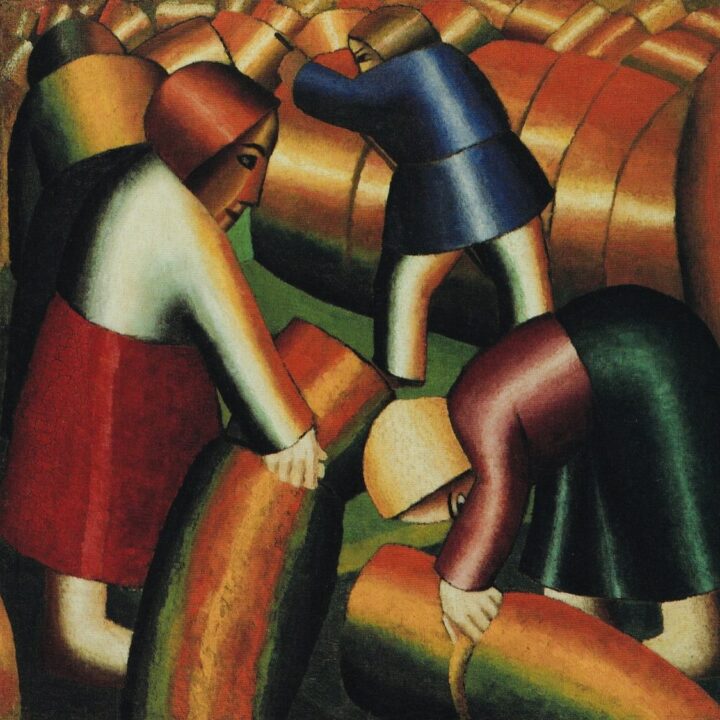
Malevich, Taking in the Rye (1912)

Malevich, Four Squares (1915)
From Berlin, he went to Dessau to meet with members of the Bauhaus, including Walter Gropius and László Moholy-Nagy, who published and distributed Suprematism in the Additional Element in Art. The new Bauhaus was regarded as the most progressive school for modern art, architecture and design. Malevich may have hoped to teach there. His tenure at UNOVIS would later be considered the “Bauhaus of the East.”
His trip was terminated, however, and he had to return to the Soviet Union before his exhibition was over. He left his paintings, models and charts in the care of a curator. Perhaps because he had plans to travel and exhibit in other places, he left instructions that his work not be sent back. As much of his work would be lost or hidden, the paintings he left in Germany would be the only ones available for future retrospectives until the dissolution of the Soviet Union.
The Stalin Years
Upon returning to Leningrad (renamed from Petrograd), he continued his research at the State Institute for Art History. But since Lenin’s death in 1924, the atmosphere for artists had changed. Many of them fell out of favor. Suprematism and avant-garde art lost support, and criticism became harsh and intolerable.
Stalin’s Five-Year Plan was inaugurated in 1929 along with the All-Union Cooperative of Artists. From then on, all art could only be approved if it supported Soviet society. Stalin decided what was appropriate. Malevich’s work was deemed non-conformist, and in 1930, he was interrogated and imprisoned for two months. When he was released, his choices were either to work by himself confined in a room or to paint in the Socialist Realist style Stalin favored. He went back to figurative painting with proletariat themes. Some of his works still contained Suprematist elements, and he was allowed to exhibit his purely Suprematist paintings alongside new ones.
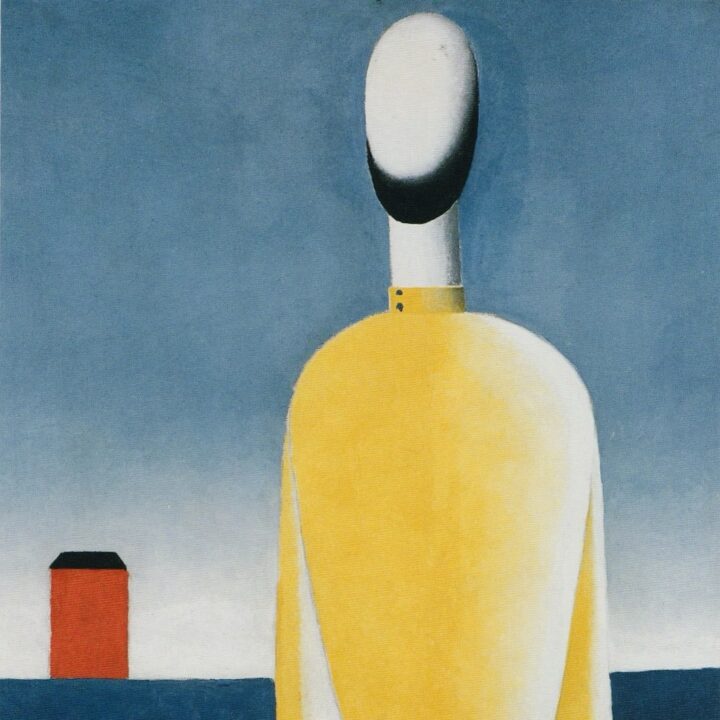
Malevich, Complex Premonition (c. 1932)
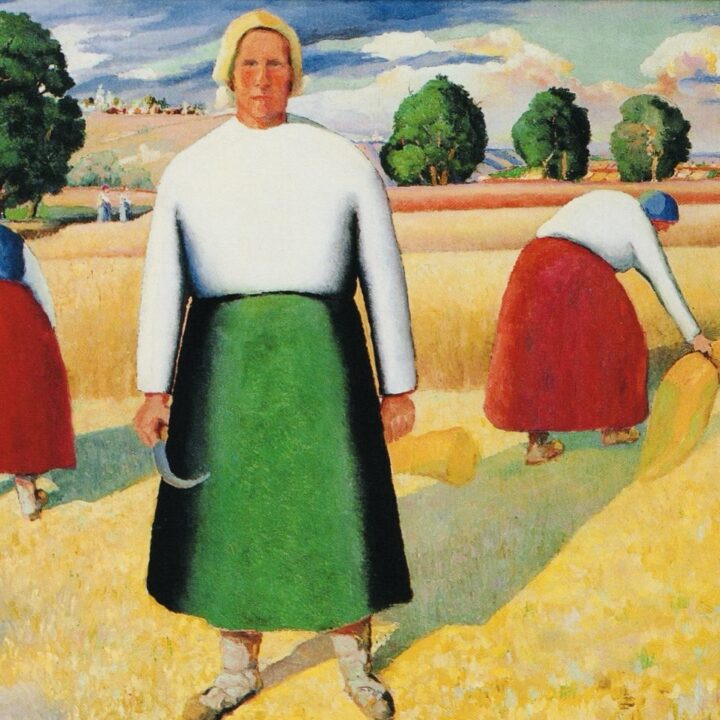
Malevich, Reapers (c. 1932)
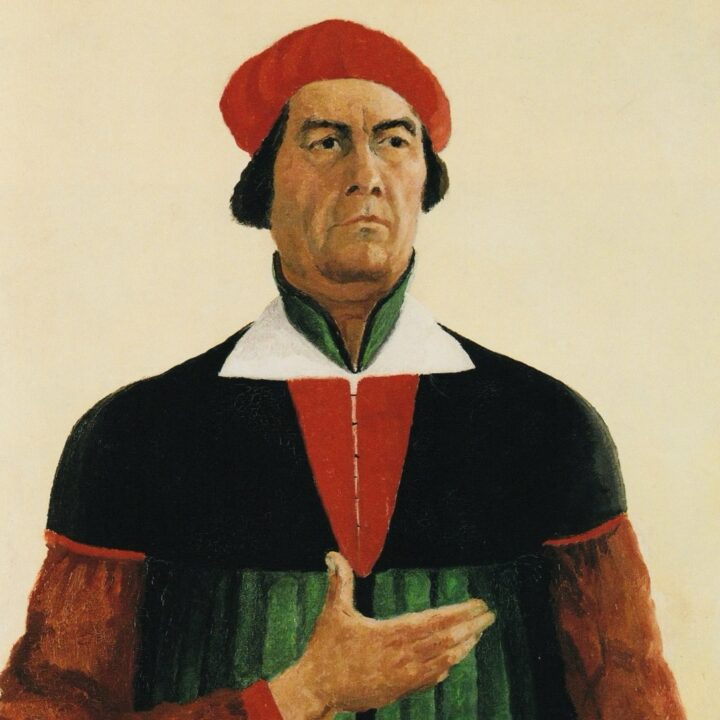
Malevich, Self-Portrait (1933)
In 1934, however, Socialist Realism became the exclusive style permitted for Soviet artists and writers. Malevich died of cancer the following year, and his works were not exhibited again in the Soviet Union for almost three decades.
Abstract Art
In tracing back the history of abstract art, two seminal figures emerge, both from the Russian avant-garde – Vasily Kandisnky, hailed as the father of abstract expressionism, and Malevich, the pioneer of geometric abstraction. It is impossible to imagine modern art without them. Malevich’s reach goes even further; his Architektons has inspired the Bauhaus, Zaha Hadid and parametric design.

Malevich, Modern Buildings (1924)